

How Many Hours of Study Are Really Needed to Crack UPSC?
Ask ten toppers how many hours to study for UPSC, and you will get ten different answers anywhere from six to fourteen. That range is exactly why the question confuses so many aspirants. The honest answer is that there is no single magic number that guarantees selection. But there is a benchmark that separates aspirants who are genuinely competing from those who are merely occupying a chair, and understanding it matters more than any timetable you copy from the internet.
The Honest Answer: There Is No Magic Number but There Is a Benchmark
The Civil Services Examination is not a test of a single day’s effort. It is a fifteen-to-eighteen-month endurance event covering a syllabus so vast that no one ever finishes it you run out of time before the exam does. In that setting, the number of hours you study for UPSC becomes a proxy for how much of that syllabus you can realistically cover, revise, and convert into marks.
For a serious full-time aspirant, we believe the honest benchmark is ten to eleven hours of rigorous, focused study per day. Not glancing at notes with a phone buzzing nearby genuine, distraction-free work. That figure is not arbitrary. When you account for reading, note-making, current affairs, answer writing, and revision across nine papers plus an optional, anything materially less than that leaves parts of the syllabus permanently under-prepared.
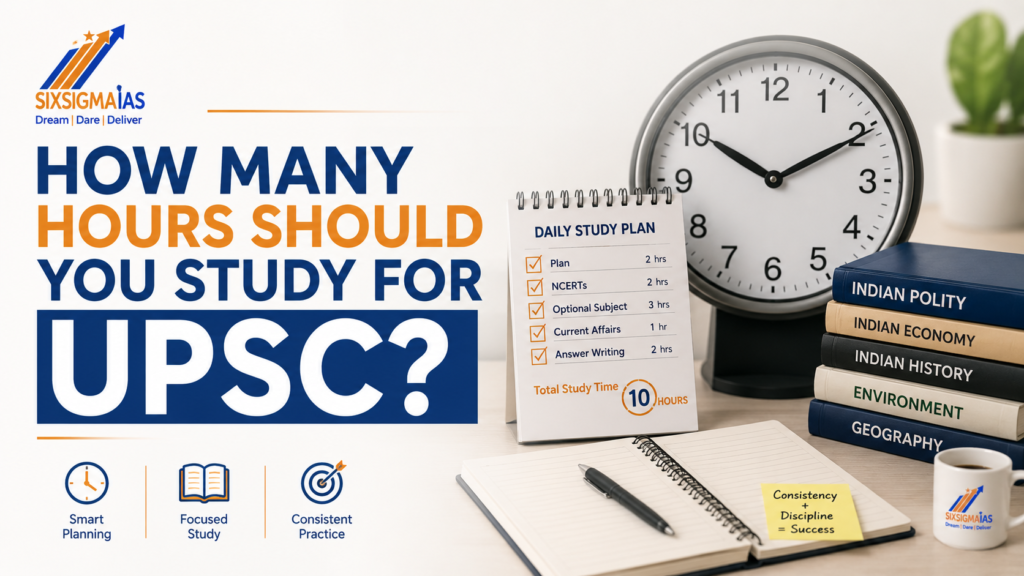
Why Ten to Eleven Hours Is the Realistic Target ?
Break the day down and the number stops sounding extreme. A committed aspirant who studies for UPSC full-time typically needs:
- 3–4 hours for core static reading and note-making across GS subjects
- 1.5–2 hours for current affairs and linking them to the syllabus
- 2 hours for optional subject preparation
- 1.5–2 hours for daily answer writing and revision
- 1 hour for consolidation, tests, or backlog
That already adds up to roughly ten to eleven productive hours and this is before the pressure of the final months, when mock tests and full-length revision push the load higher. Aspirants who consistently put in these hours over twelve to fifteen months build the depth and speed that the exam quietly rewards. Those who plateau at four or five hours almost always find themselves with an unfinished syllabus and shallow revision when it matters most.
Effective Hours Matter More Than Clock Hours
Here is the caveat that keeps this advice honest: the goal is ten to eleven effective hours, not ten to eleven hours of sitting. A distracted twelve-hour day, punctuated by social media and daydreaming, is worth less than a focused seven. When you decide how many hours to study for UPSC, count only the time when you were fully engaged in reading actively, writing answers, and testing recall.
Most aspirants dramatically overestimate their real study hours. A simple discipline fixes this: track your genuinely focused blocks for one week. Almost everyone discovers a gap of two to three hours between what they think they studied and what they actually did. Closing that gap is often more valuable than adding hours to the timetable.
How Many Hours by Situation
Not everyone is a full-time aspirant, and the honest number shifts with circumstance:
- Full-time aspirants: Ten to eleven focused hours is the target once you have built up to it. This is the group for whom the benchmark truly applies.
- Beginners in month one: Do not start at eleven hours you will burn out in a fortnight. Begin at five to six focused hours and add roughly an hour every ten days until you reach the benchmark. Stamina for study is trainable, exactly like physical stamina.
- Working professionals: Ten hours is not realistic on a working day. Aim for four to five ruthlessly focused hours on weekdays and long, disciplined sessions on weekends. Consistency over eighteen months matters far more than raw daily hours here.
Consistency Beats Marathon Days
One fourteen-hour burst followed by three idle days is worse than steady ten-hour days, every time. The syllabus is conquered by accumulation, not heroics. Sustainable Rigour, protecting your sleep, taking short breaks, and keeping one lighter day a week is what allows you to hold ten to eleven hours for over a year without collapsing. An aspirant who studies for UPSC hard but sleeps five hours a night is quietly sabotaging the very memory and focus the exam demands. Rigour and recovery are partners, not rivals.
So when you ask how many hours to study for UPSC, the real question underneath is: can I sustain deep, focused, ten-to-eleven-hour days, consistently, for as long as this exam takes? Build toward that honestly, and the timetable takes care of itself.
At Six Sigma IAS, our mentorship led by ex-civil servants, including Dr Shikha Darbari (1990-batch IRS), helps aspirants convert study hours into marks through daily answer writing, structured revision, and honest accountability. Visit us at C-6, Ground Floor, Sector 2, Noida, near Noida Sector 15 Metro Station.
Frequently Asked Questions (FAQs)
For a serious full-time aspirant, ten to eleven hours of focused, distraction-free study per day is a realistic benchmark. This covers static reading, current affairs, the optional subject, answer writing, and revision without leaving parts of the syllabus permanently under-prepared. Build up to it gradually rather than starting there on day one.
Yes. It is possible, especially for working professionals or fast readers with strong retention, but it demands exceptional efficiency and near-zero wasted time. Most successful full-time aspirants find that six hours simply does not allow enough coverage plus revision, which is why ten to eleven focused hours remains the safer target.
No and this distinction is critical. Only fully engaged time counts. A distracted ten hours can be worth less than a focused six. Track your genuinely focused blocks for a week and most aspirants find a two-to-three-hour gap between perceived and actual study.
Protect your sleep, take short scheduled breaks, keep one lighter day each week, and build your daily hours up gradually over the first month. Rigour and recovery work together; sustainable long-term consistency beats occasional fourteen-hour marathons every time.