
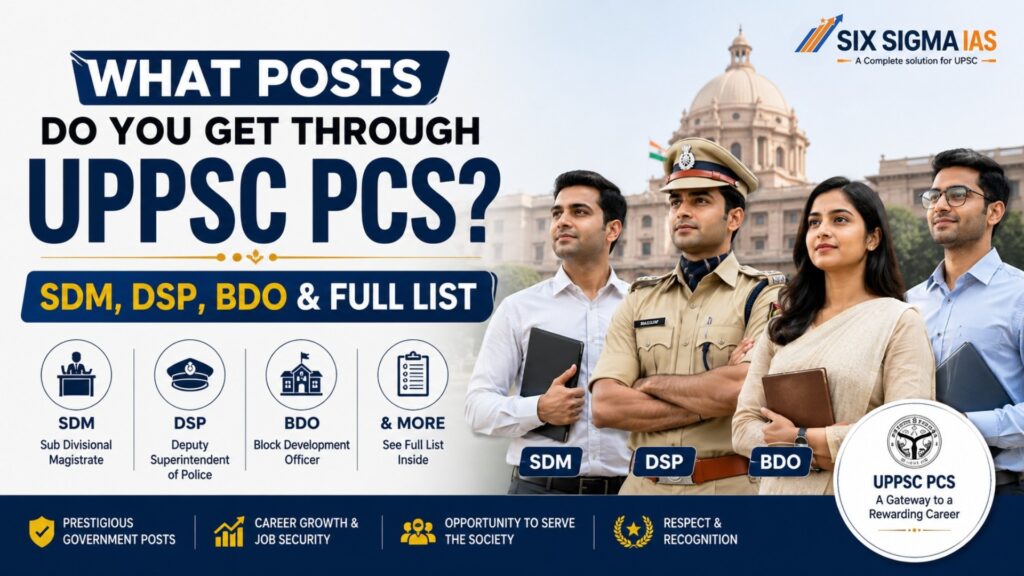
What Posts Do You Get Through UPPSC PCS? SDM, DSP, BDO & Full List
Every year, lakhs of aspirants in Uttar Pradesh sit for one exam with a single dream in mind: to wear the authority of a state administrator. But if you ask most first-time candidates which post they are actually competing for, the answer is usually a vague “SDM banna hai.” The truth is that UPPSC PCS opens the door to more than 30 Group A and Group B posts, and understanding this hierarchy early can shape your entire preparation strategy. This guide walks you through the full ladder from the marquee roles to the allied services most aspirants overlook.
First, What Is UPPSC PCS?
The Uttar Pradesh Combined State / Upper Subordinate Services Examination, commonly called UPPSC PCS, is conducted by the Uttar Pradesh Public Service Commission to recruit officers for the state’s administrative, police, revenue, and development departments. It runs across three stages: Prelims, Mains, and Interview. Candidates are then allotted posts strictly based on merit and the preference order they submit, subject to category reservation. In short, your rank decides your uniform.
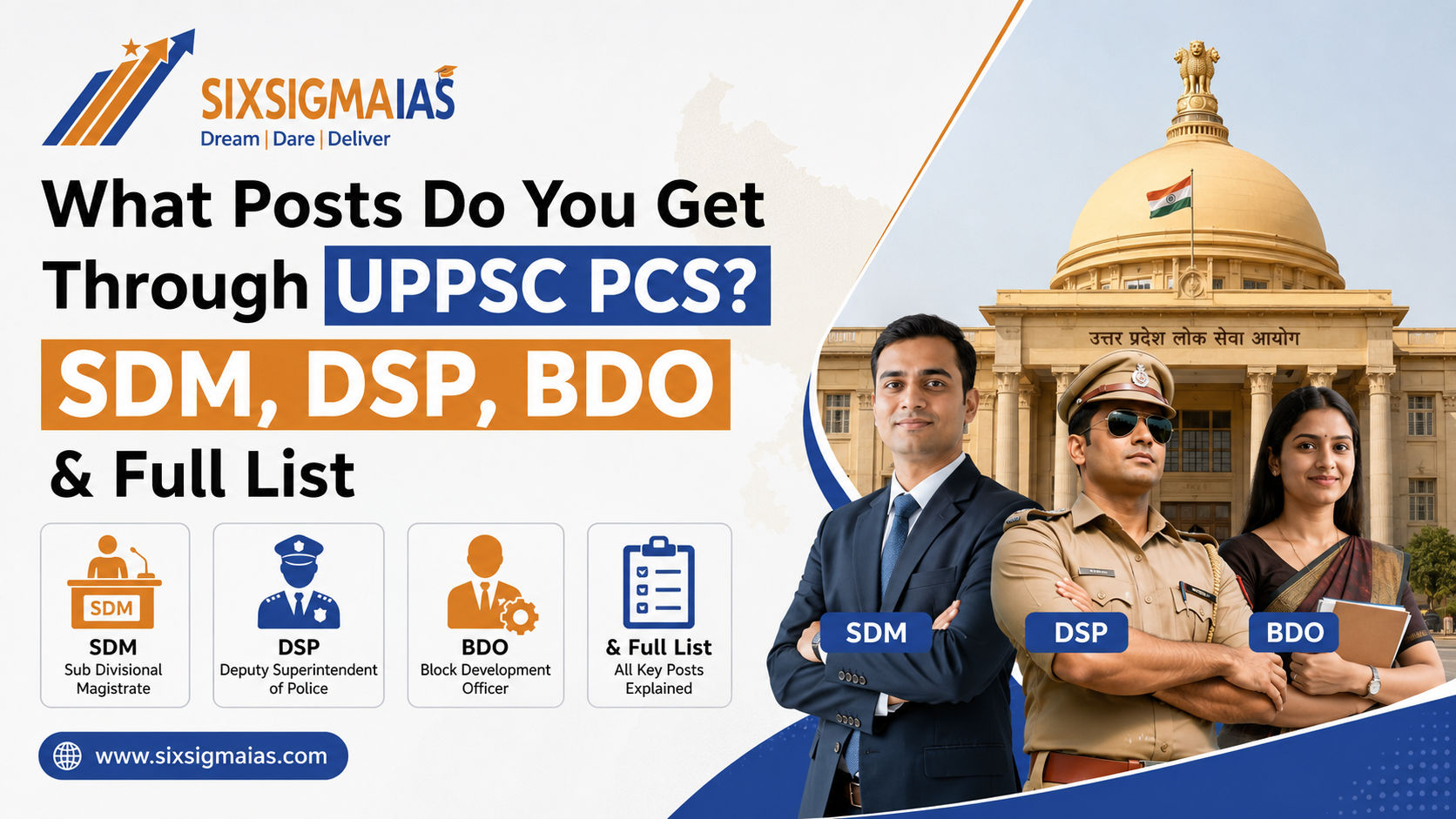
The “Big Three” Posts Everyone Talks About: When people picture a PCS officer, three posts dominate the imagination, and all three sit at Pay Level 10.
- Sub-Divisional Magistrate (SDM) / Deputy Collector: This is the most coveted post in UPPSC PCS. An SDM runs the revenue and general administration of a sub-division, handles land records, oversees law and order, and supervises elections and disaster response in their jurisdiction. With experience, an SDM can rise to City Magistrate, Additional District Magistrate, and through eventual promotion to the IAS even higher.
- Deputy Superintendent of Police (DSP) The police wing of the exam. A DSP supervises a police circle, leads investigations in serious cases, and maintains order on the ground. The promotional path runs through Additional SP and Superintendent of Police, with the possibility of induction into the IPS after long, meritorious service.
- Block Development Officer (BDO) The face of rural governance. A BDO heads the block administration and drives flagship schemes like MGNREGA, supervising panchayats and acting as the bridge between the district and the villages. For candidates drawn to grassroots development work rather than law and order, this is the heart of the job.
The Wider Hierarchy: Group A and Group B Posts
The three posts above get the headlines, but UPPSC PCS recruits for a much broader set of roles. These are broadly split into two tiers.
- Group A (Gazetted, senior) posts include Deputy Collector (SDM), DSP, District Commandant Home Guards, Assistant Commissioner (Commercial Tax), Treasury/Accounts Officer, and District Programme Officer, among others.
- Group B posts, often at Pay Level 8, include roles such as Naib Tehsildar, Assistant Registrar (Cooperative Societies), District Basic Education Officer, District Backwards Welfare Officer, District Minority Welfare Officer, Assistant Prosecution Officer (APO), District Cane Officer, and District Savings Officer.
The exact list of vacancies changes with each notification, so the service-wise breakup published on uppsc.up.nic.in is always the authoritative source. But the pattern is consistent: revenue, police, development, welfare, and finance departments all draw their officer cadre from this single examination.
How Posts Are Actually Allotted
This is where many aspirants misunderstand the system. Your final marks determine your rank, and posts are filled from the top of the merit list downward according to each candidate’s stated preference and reservation category. A top-ranked candidate who lists SDM first will likely get it; a mid-list candidate may find SDM exhausted and land a Group B post instead. This is precisely why aspirants should treat every mark as decisive; the difference between an SDM and a Naib Tehsildar is often a handful of marks in the Mains answer sheets.
As Dr Shikha Darbari often reminds candidates at Six Sigma IAS, the biggest strategic error is preparing for “a government job” in the abstract rather than aiming, from day one, at the specific post you want. Knowing the hierarchy turns a vague ambition into a measurable target.
A Note on Preparation Strategy
The single most important recent change worth building your plan around: UPPSC PCS Mains no longer has optional subjects. They have been replaced by two compulsory Uttar Pradesh-specific General Studies papers covering UP history, culture, governance, economy, and geography, together worth 400 of the merit marks. Since every candidate now writes identical papers, strong UP-specific knowledge and disciplined answer writing have become the true differentiators between an SDM aspirant and everyone else.
At Six Sigma IAS, the guidance to serious UPPSC PCS candidates is straightforward: decide your target post early, reverse-engineer the marks you need, and give the UP-specific papers the dedicated study they demand rather than treating them as an afterthought.
Frequently Asked Questions (FAQs)
The Sub-Divisional Magistrate (SDM) / Deputy Collector is generally regarded as the top post, given its administrative authority and its eventual pathway to the IAS.
SDM handles revenue and general administration, DSP handles policing and law enforcement, and BDO handles rural development at the block level. All three sit at Pay Level 10.
Purely by merit rank, combined with the candidate's preference order and category reservation. Higher rank means a wider choice of posts.
Yes ,the exam recruits for 30+ Group A and Group B posts, including Naib Tehsildar, Assistant Prosecution Officer, Treasury Officer, District Programme Officer, and several welfare and cooperative department roles.
Yes. Through seniority and the state's promotion quota, an SDM can be inducted into the IAS and a DSP into the IPS after long and meritorious service.
The vacancy list, eligibility, and service-wise breakup vary with each cycle always cross-check the latest official notification on uppsc.up.nic.in before applying.