
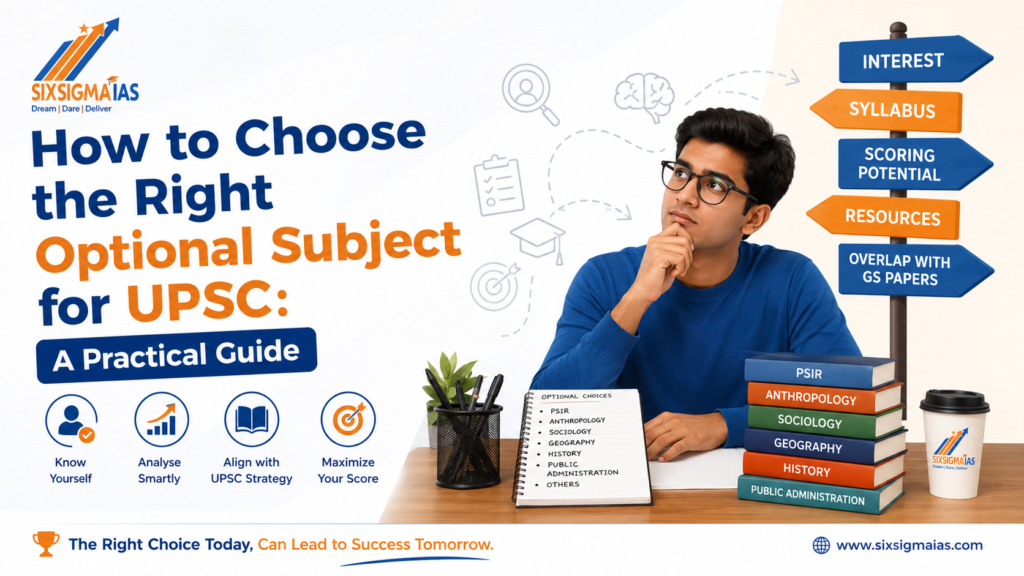
How to Choose the Right Optional Subject for UPSC: A Practical Guide
Few decisions in the civil services journey feel as heavy as choosing the optional subject for UPSC. It is the one part of the Mains examination where you exercise genuine choice, and that choice quietly shapes the next two years of your preparation your reading, your revision, your confidence in the examination hall, and ultimately a large slice of your final marks. Yet many aspirants arrive at this decision anxiously and settle it hastily, often on the basis of hearsay or a friend’s recommendation. This guide is written to slow that decision down and make it a reasoned one.
Why the Optional Subject Carries So Much Weight
In the Mains examination, the optional subject for UPSC comprises two papers of 250 marks each, for a total of 500 marks. To put that in perspective, this single subject carries more marks than any individual General Studies paper. A candidate who scores consistently well in the optional builds a cushion that can be the difference between a place in the final list and a near miss. Equally, a poorly chosen optional can drag down an otherwise strong performance. The stakes, therefore, are real, and they justify spending genuine thought at the outset rather than course-correcting painfully later.
There is a second, subtler reason the choice matters. You will live with this subject for a very long time. Preparation, revision, test practice, and for many a second or third attempt all revolve around it. A subject you find tedious becomes a daily tax on your motivation. A subject that genuinely interests you sustains you through the long, unglamorous months when discipline alone is not enough.
The Real Criteria for Choosing an Optional Subject for UPSC
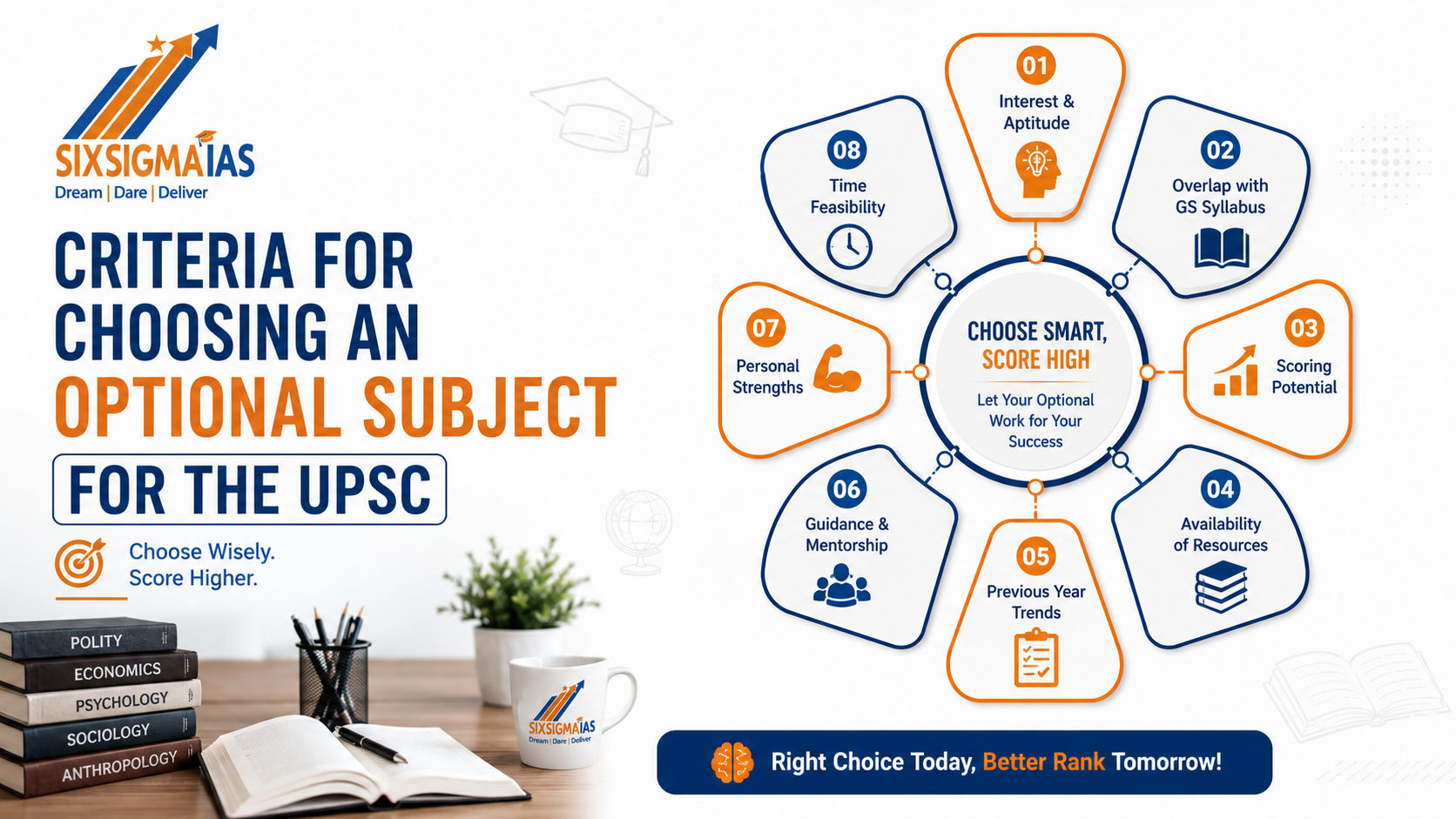
Aspirants often ask which optional is “best.” The honest answer is that there is no universally best optional only the one best suited to you. That said, the decision is far from arbitrary. Weigh the following criteria together rather than in isolation.
- Genuine interest and aptitude. Start here, because everything else depends on it. If you find yourself reading around a subject even when you are not obliged to, that is a strong signal. Aptitude matters too: some candidates think naturally in analytical, argument-driven terms and take to subjects like Political Science or Sociology; others are more comfortable with factual, structured material and prefer Geography or History. Be honest about how your mind actually works, not how you wish it worked.
- Overlap with the General Studies syllabus: A well-chosen optional does double duty. Subjects such as Geography, History, Political Science and International Relations (PSIR), Sociology, and Public Administration share meaningful ground with the GS papers and even with the Essay and Prelims. This overlap is not a minor convenience; it can save you weeks of separate study while reinforcing your GS preparation. When two subjects appeal to you roughly equally, the one with greater GS overlap deserves the edge.
- Availability of quality guidance and study material: An optional is only as strong as the support around it. Ask whether reliable materials, previous years’ questions, standard reference books, and, crucially, experienced mentorship are readily available for the subject. A brilliant but obscure optional with thin guidance can leave you stranded. This is precisely where structured mentorship earns its value: a mentor who has seen the subject tested across many cycles can tell you what the syllabus really demands and where candidates typically lose marks.
- Scoring trends and consistency: Look at how the subject has behaved over recent examination cycles. Some optionals reward preparation predictably; others are more volatile, with marks swinging sharply from one year to the next. You are not chasing a guaranteed high score; no such thing exists, but you are looking for a subject where sincere, sustained effort translates reliably into marks. Consistency of scoring is often more valuable than the occasional spectacular result.
- Your academic background: If you hold a degree in a subject that is also an optional, you may already possess a foundation that shortens your learning curve. This is an advantage worth using, but do not treat it as decisive. A background subject you disliked at university is not automatically the right optional for UPSC, and many successful candidates have chosen subjects entirely new to them. Treat your academic history as one input, not the verdict.
- Time available before the examination: Optionals differ in the sheer volume of material they demand and in how long they take to build from scratch. A candidate with a comfortable runway can afford a content-heavy subject; one attempting the examination on a compressed timeline may be better served by a more compact, self-contained optional. Match the subject to the time you honestly have, not to the time you wish you had.
Common Mistakes to Avoid
Several recurring errors turn this decision sour, and being aware of them is half the battle. The most frequent mistake is choosing by trend, picking whichever optional appears fashionable in a given year because “everyone is taking it.” Popularity tells you nothing about your own fit, and crowded optionals bring their own competitive pressures. A close cousin of this error is choosing by imitation, selecting a subject only because a friend, a topper, or a coaching advertisement endorsed it. What worked for another candidate, with a different mind and background, may not work for you.
Aspirants also underestimate the syllabus of subjects that appear deceptively simple, and overestimate their stamina for subjects they find dull. And a surprising number never actually read the detailed syllabus and a few previous years’ question papers before committing a mistake that a single afternoon of honest homework would prevent.
A Simple Framework to Decide
If you are still torn, work through this sequence rather than agonising abstractly. First, shortlist two or three optionals that genuinely interest you. Second, download the official syllabus and the last four or five years of question papers for each, and read them carefully; this alone eliminates poor fits quickly. Third, attempt a few sample answers or study a couple of topics in each to feel how the subject sits with you in practice. Fourth, weigh each shortlisted subject against the six criteria above: interest, GS overlap, guidance, scoring, background, and time. Finally, and only then, commit and having committed, stay the course rather than second-guessing after the first difficult week.
Where Mentorship Makes the Difference
Choosing the right optional subject for UPSC is one of those decisions where an experienced outside perspective is genuinely worth seeking. A candidate deciding alone can only see the subject from the inside; a seasoned mentor can place it against years of examination trends and the experiences of many candidates. At Six Sigma IAS Academy, this is exactly the kind of foundational conversation we encourage aspirants to have early, before they invest months in the wrong direction. Under the mentorship of Dr. Shikha Darbari, the emphasis is on matching each candidate to a subject that fits their temperament and strengths not on steering everyone toward whatever optional happens to be popular that season. A short, honest discussion at this stage can save an aspirant an enormous amount of misdirected effort later.
Conclusion
The optional subject for UPSC is not a box to be ticked quickly and forgotten. It is a two-year companion and a 500-mark opportunity, and it rewards candidates who choose deliberately. Weigh interest against aptitude, factor in GS overlap, insist on good guidance, study the scoring trends, and be honest about your background and your timeline. Do the unglamorous homework of reading the syllabus and past papers before you decide. Choose well, commit fully, and the optional stops being a source of anxiety and becomes one of your surest sources of marks.
Frequently Asked Questions
You choose one optional subject, which is examined through two papers of 250 marks each, for a combined total of 500 marks.
Not automatically. A background in the subject can shorten your learning curve, but it should be weighed alongside your genuine interest, the subject's overlap with General Studies, and the quality of guidance available. Many successful candidates have chosen optionals unrelated to their degree.
There is no single best optional. The right choice depends on your interest, aptitude, academic background, the time you have, and the guidance available to you. A subject that suits one candidate may not suit another.
Several optionals — such as Geography, History, PSIR, Sociology, and Public Administration — share meaningful ground with the GS syllabus, which can make your preparation more efficient. Where two subjects appeal to you equally, greater GS overlap is a sensible tie-breaker.
As early as you reasonably can, ideally near the start of your preparation, so that you can integrate it with your GS study from the outset. Rushing the decision or delaying it repeatedly both cost you valuable time.
It is possible, and some candidates do switch, but changing midway is costly in time and momentum. This is precisely why the initial decision deserves careful thought and, ideally, a mentor's guidance before you commit.