
How to Start UPSC Preparation from Scratch in 2026: Complete Beginner's Guide
Every year, close to a million aspirants sit for one of the toughest examinations in the world — and almost all of them started exactly where you are right now: at zero. If you have decided that 2026 is the year you begin your civil services journey, this UPSC preparation for beginners guide is written for you. No jargon, no assumptions, no prior background required. Just a clear, honest roadmap for UPSC preparation from scratch.
Before we get into strategy, one important reality check about timing — because it changes everything about how you should plan.
First, understand the 2026–2027 timeline
The UPSC Civil Services Examination (CSE) 2026 notification was released in February 2026, the Prelims were held on 24 May 2026, and the Mains begin on 21 August 2026. In other words, the 2026 cycle is already well underway.
So if you are starting fresh in the second half of 2026, your realistic first serious target is the UPSC CSE 2027 cycle — Prelims are scheduled for 23 May 2027 and Mains from 20 August 2027. That gives a beginner roughly ten months of runway to the 2027 Prelims, which is enough to build a genuine foundation if you start now and stay consistent.
This is the honest framing most generic guides skip: you are not preparing for “someday.” You are preparing for a fixed date in May 2027. Everything below is built around that.
What is the UPSC Civil Services Exam, really?
The UPSC CSE is the gateway to the IAS, IPS, IFS, IRS and other top All-India and Central Services. It is a single examination conducted in three stages:
- Prelims (Preliminary Examination)— a screening test. Objective/MCQ format. Marks here do not count toward your final rank; they only decide whether you clear the cut-off and move to Mains.
- Mains (Main Examination)— nine descriptive papers. This is where your rank is largely decided.
- Personality Test (Interview)— a face-to-face board assessment.
Understanding this three-stage structure is the foundation of any sensible IAS preparation guide, because each stage demands a very different skill — recognition and elimination for Prelims, structured writing for Mains, and clarity of thought for the interview.
Check your eligibility before you invest a year
Spend ten minutes confirming you are actually eligible before you commit months of effort:
- Nationality:Indian citizen (for IAS and IPS specifically; some services have relaxed rules).
- Educational qualification:A Bachelor’s degree in any discipline from a recognised university. Your stream does not matter — engineers, doctors, arts and commerce graduates all compete on the same footing.
- Age:Generally 21 to 32 years for the General category (as on 1 August of the exam year), with relaxations for OBC, SC/ST and PwBD candidates.
- Number of attempts:6 for General and EWS, 9 for OBC, and unlimited (up to the age limit) for SC/ST, with separate provisions for PwBD candidates.
These are the standard conditions, but eligibility details can be revised — always confirm against the official notification at upsc.gov.in for your target year.
The exam pattern you’re preparing for
You cannot design a study plan without knowing exactly what you’re being tested on. Here is the structure at a glance.
Prelims (same day, two papers):
- GS Paper I— 100 questions, 200 marks, 2 hours. This is the paper whose score decides your Prelims cut-off.
- CSAT Paper II— 80 questions, 200 marks, 2 hours. This is qualifying only; you need 33% (66 marks) to pass, but it does not add to your merit. Never ignore CSAT, though — a surprising number of well-prepared aspirants fail Prelims purely because they treated CSAT as an afterthought.
- Both papers carry a negative markingof one-third of the marks for each wrong answer.
Mains (nine papers):
- Two language papers (one Indian language + English) that are qualifying only.
- Essay(250 marks), General Studies I–IV (250 each), and two Optional Subject papers (250 each).
- The seven papers that count toward merit total 1750 marks, and the Personality Test adds 275 marks— a grand total of 2025 marks that decides your final rank.
Knowing this weightage is the heart of a good UPSC exam strategy: Mains and the interview decide your rank, so Prelims should be cleared efficiently, not obsessively over-prepared at the cost of Mains skills.
Decode the UPSC syllabus 2026 (don’t just download it — study it)
The single most valuable document in your preparation is the official syllabus. Print it. Read it line by line. Then read it again after two months — you will understand it completely differently.
At a high level, the UPSC syllabus 2026 covers:
- History— Ancient, Medieval, Modern India, and the freedom struggle.
- Geography— Physical, Indian, and world geography, plus resource distribution.
- Polity & Governance— the Constitution, political system, panchayati raj, public policy, rights issues.
- Economy— economic development, planning, growth, inclusion, budgeting.
- Environment & Ecology— biodiversity, climate change, conservation.
- Science & Technology— everyday science plus current developments.
- Current Affairs— the connective tissue that ties every subject to the real world.
- Ethics (GS Paper IV)and one Optional Subject of your choice at the Mains stage.
The syllabus barely changes year to year, which is good news: the material you build now stays valid. What changes is current affairs, which is why beginners must marry static subjects with daily news from day one.
How to prepare for UPSC from scratch: a 7-step roadmap
This is the core of the guide — the actual sequence a beginner should follow. Do not skip steps or jump ahead to “advanced” material before the foundation is laid.
Step 1 — Read the syllabus and previous year questions (PYQs). Before opening a single textbook, study 3–4 years of Prelims and Mains PYQs alongside the syllabus. You are not solving them yet; you are learning what UPSC actually asksand how deep you need to go. This single habit prevents months of over-reading irrelevant material.
Step 2 — Build your base with NCERT textbooks. NCERTs (Class 6 to 12) in History, Geography, Polity, Economy and Science are the bedrock of UPSC preparation for beginners. They are clear, authoritative and written for first-time learners. Finish these before touching standard reference books — they make everything afterward easier.
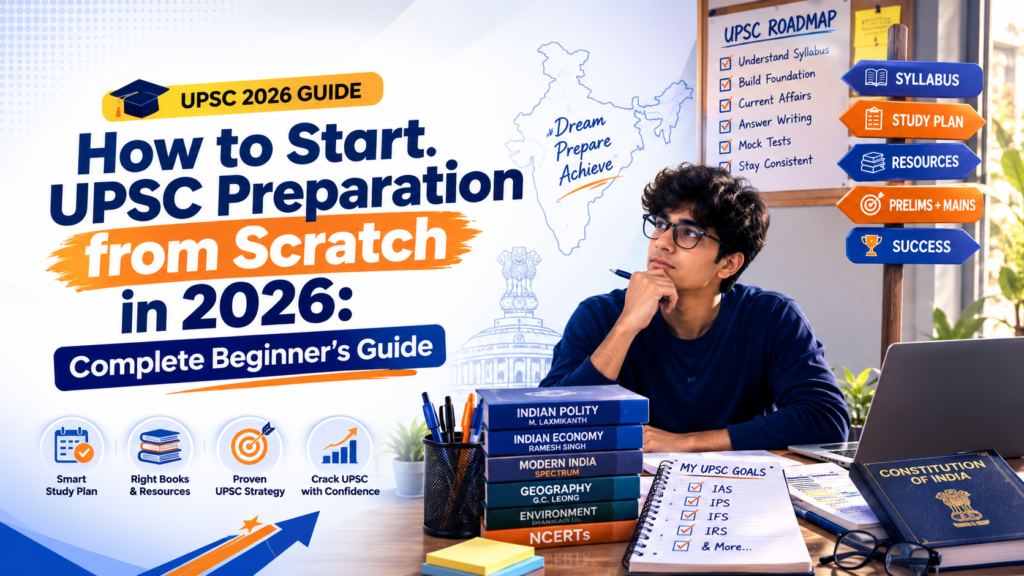
Step 3 — Move to standard subject-wise books. Once your NCERT base is solid, layer on the standard references: Indian Polity by Laxmikanth, A Brief History of Modern India (Spectrum), Certificate Physical & Human Geography by G.C. Leong, Indian Economy by Ramesh Singh, and Environment by Shankar IAS. Read fewer books more times rather than many books once.
Step 4 — Make current affairs a daily habit. Read one good newspaper (The Hindu or The Indian Express) every single day and maintain concise monthly notes. Current affairs is not a subject you “finish” — it is a discipline you sustain for the entire journey.
Step 5 — Start answer writing early. Mains rewards structured, time-bound writing, and this is a skill that takes months to build. Begin writing short answers as soon as your basics in a subject are in place. Waiting until after Prelims is one of the most common — and costly — beginner errors.
Step 6 — Choose your optional subject thoughtfully. Pick an optional based on your interest, comfort, availability of guidance and overlap with GS. Choose it early (within the first 3–4 months) so you have time to build depth. We cover this in detail in our dedicated post on optional subject selection.
Step 7 — Revise relentlessly and take tests. Reading once is worthless without revision. Build revision into your schedule from the start, and begin taking Prelims mock tests and Mains answer-writing tests in the final months to convert knowledge into exam performance.
A sample UPSC study plan (from scratch to May 2027)
Here is a realistic UPSC study plan for a beginner starting in mid-2026 and targeting the 23 May 2027 Prelims. Treat it as a skeleton to adapt, not a rigid cage.
|
Phase |
Timeframe |
Focus |
|
Foundation |
Aug – Sep 2026 |
Study the syllabus + PYQs; finish core NCERTs (Class 6–12); start the daily newspaper habit |
|
Core building |
Oct – Dec 2026 |
Standard books subject-wise; continue current affairs; select your optional; begin basic answer writing |
|
Consolidation |
Jan – Feb 2027 |
Complete GS static portions; go deeper into optional; start CSAT practice; first full revision |
|
Prelims mode |
Mar – Apr 2027 |
Intensive PYQs and mock tests; revision; consolidate one year of current affairs |
|
Final sprint |
May 2027 |
Full-length mocks, rapid revision → Prelims: 23 May 2027 |
|
Mains phase |
Jun – Aug 2027 |
Intensive answer writing, essay and optional practice → Mains: 20 Aug 2027 |
Consistency beats intensity. A steady 6–8 focused hours a day for ten months will take you far further than sporadic 14-hour bursts followed by burnout.
The beginner mistakes that quietly kill preparations
Most aspirants don’t fail for lack of effort — they fail from avoidable strategic errors: hoarding too many books, ignoring PYQs, delaying answer writing, neglecting CSAT, chasing every coaching material online, and abandoning revision. Being aware of these traps from day one is half the battle. (We break each of them down in our companion post on common UPSC preparation mistakes.)
Do you need coaching to start from scratch?
Self-study is absolutely possible, and many toppers have done it. But a good mentor shortens the learning curve dramatically — helping you avoid wrong turns, structure your UPSC study plan, choose the right optional, and get honest feedback on your answer writing. For a complete beginner, that guidance in the first few months is often the difference between a confused first year and a productive one.
At Six Sigma IAS Academy, our programmes are mentored by former civil servants — including ex-IRS officers — who have lived the system you’re preparing to enter. If you are starting from scratch in 2026 and want a structured foundation, expert answer-writing feedback, and a study plan built around the real 2027 timeline, we would be glad to guide you.
👉 Explore our beginner-friendly UPSC/IAS programmes at sixsigmaias.com or reach out to our mentors today.
Frequently Asked Questions
- Can a complete beginner clear UPSC in the first attempt?Yes. Many first-time aspirants clear UPSC with a well-structured plan, disciplined revision and early answer-writing practice. Starting from scratch is not a disadvantage if you begin the right way.
- How many hours a day should a beginner study for UPSC?A consistent 6–8 focused hours a day is more effective than occasional long sessions. Quality, revision and consistency matter far more than raw hours.
- Which books should I start with for UPSC preparation from scratch?Begin with NCERT textbooks (Class 6–12) across History, Geography, Polity, Economy and Science, then move to standard references like Laxmikanth, Spectrum, G.C. Leong, Ramesh Singh and Shankar IAS.
- When should I start current affairs preparation?From day one. Read one good newspaper daily and maintain monthly notes throughout your preparation — current affairs connects every subject in the syllabus.
- If I start in 2026, which exam should I target?Since the 2026 Prelims are already over, a beginner starting in the second half of 2026 should target the UPSC CSE 2027 cycle (Prelims on 23 May 2027), which gives roughly ten months of preparation time.
Final word
Starting UPSC preparation from scratch in 2026 is not about knowing everything on day one — it’s about building the right foundation, in the right order, aimed at a fixed date. Read the syllabus, master the NCERTs, sustain your current affairs habit, start writing early, and revise without mercy. Do that consistently for the next ten months, and the May 2027 Prelims will meet a very different version of you.
Your journey begins the moment you turn the page — so begin today.
Six Sigma IAS Academy, Sector 2, Noida — UPSC & UPPSC preparation mentored by former civil servants. Visit sixsigmaias.com.