

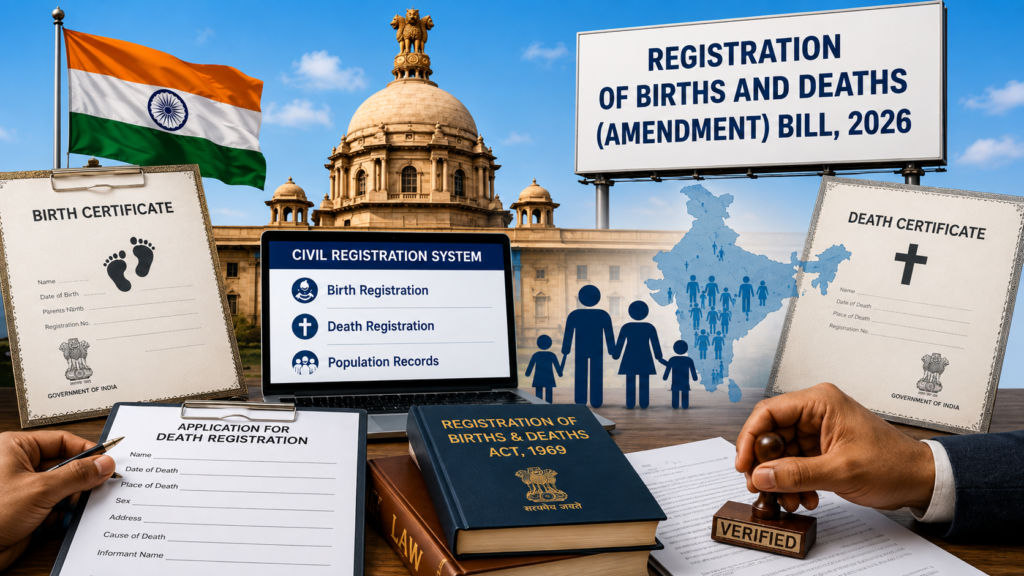
Registration of Births and Deaths (Amendment) Bill, 2026
Key Highlights
- The Lok Sabhapassed the Registration of Births and Deaths (Amendment) Bill, 2026 by voice vote.
- Introduces a two-tier approval mechanismfor delayed registration of births and deaths:
- Delay of 1–2 years:Approval of the District Magistrate (DM), Sub-Divisional Magistrate (SDM), or an authorized Executive Magistrate is required.
- Delay of more than 2 years:Registration requires an order from a Judicial Magistrate of the First Class (JMFC) after due verification.
- The amendment aims to prevent fraudulent registrations, improve the accuracy of demographic records, and strengthen population databases used for welfare schemes.
Important Terms
- Civil Registration System (CRS):The statutory system for continuous and compulsory registration of births and deaths.
- Executive Magistrate:Administrative officer under the executive branch.
- Judicial Magistrate:Independent judicial officer responsible for judicial scrutiny.
Legal Framework
- Entry 30, Concurrent List (Seventh Schedule):Empowers both Parliament and State Legislatures to legislate on vital statistics, including registration of births and deaths.
- Registration of Births and Deaths Act, 1969:Governing legislation, previously amended in 2023.
Conclusion
The amendment strengthens the verification process for delayed registrations, particularly by introducing judicial oversight for cases delayed beyond two years, thereby enhancing the reliability and integrity of India’s demographic records.