
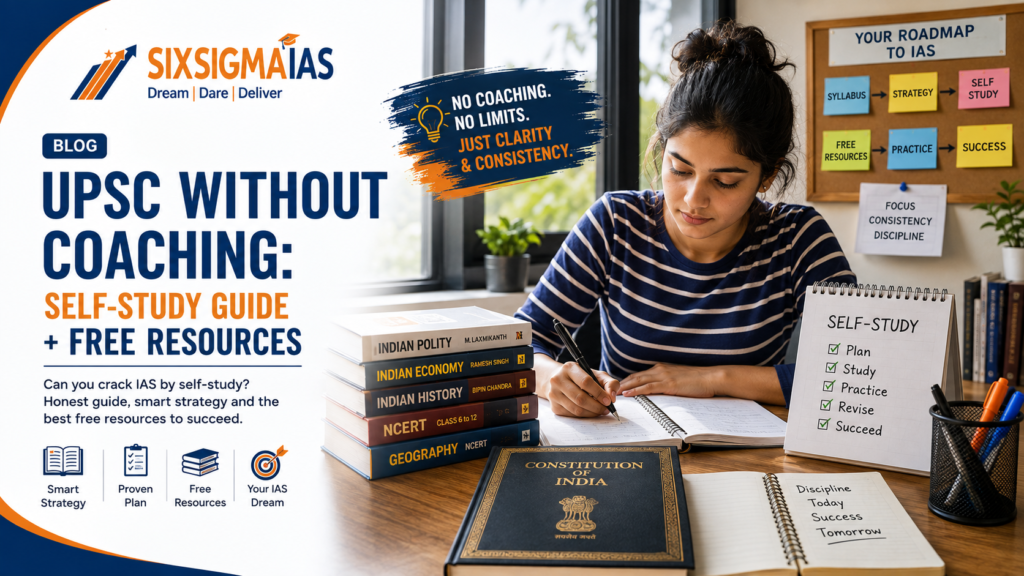
UPSC Preparation Without Coaching: Can You Crack IAS by Self-Study?
Let’s answer the question directly, and then spend the rest of this post on the part that actually matters.
Yes. You can clear the Civil Services Examination without coaching. People do it every year, including at the very top of the merit list. The syllabus is public, the previous papers are public, and very nearly every source you need is available free from a government website.
That is the easy half. The harder half is this: coaching is not one thing. It performs four separate functions, and self-study candidates fail not because they lacked a classroom but because they replaced only two or three of the four and never noticed the gap.
This post sets out what those four functions are, how to replicate each one on your own, and a verified library of free resources to build your preparation on. It is written by a coaching institute, which you should factor in — so we have tried to be specific about the one thing self-study genuinely struggles to replace, rather than vague about all of it.
The evidence that self-study works
Consider the most recent completed cycle. The Civil Services Examination 2025 result was declared on 6 March 2026, with 958 candidates recommended.
The candidate at All India Rank 1, Anuj Agnihotri, is a medical graduate from AIIMS Jodhpur who took Medical Science as his optional and cleared in his third attempt. Several coaching institutes have publicly associated themselves with parts of his preparation, principally at the interview stage. Against that, one report quotes his father saying that he never enrolled in any coaching institute and prepared through self-study.
We cannot resolve that contradiction and we are not going to pretend otherwise. But one fact about him is not in dispute and is more useful than either version: he prepared for the attempt that made him AIR 1 while serving as a DANICS probationer — that is, while holding down a full-time government job.
Whatever else that tells you, it tells you the decisive variable was not classroom attendance.
The broader numbers point the same way. In the 2026 cycle, 8,19,732 candidates applied and roughly 5.49 lakh appeared; 13,343 qualified for the Mains against 933 notified vacancies. A very large share of the aspirants in that funnel — certainly the majority — never attended a full-time classroom programme. Self-study is not a fringe route. It is the normal one.
What coaching actually provides — the four functions
This is the framework that makes UPSC without coaching a solvable problem rather than a gamble. A coaching programme bundles four distinct things. Price them separately.
Function 1: Structure
A calendar that says what to study this week, sequenced so that the syllabus finishes before the exam rather than after it.
How hard to replace: easy. This is a planning exercise, not a service. Work backwards from your exam date, reserve the revision windows first, and divide what remains across the syllabus. It takes an afternoon and costs nothing.
Function 2: Curation
Deciding what to read and — far more importantly — what not to read. A coaching programme’s real value here is subtractive: it tells you that four books on Modern History is three books too many.
How hard to replace: moderate. The information is freely available. The discipline is the difficulty, because the internet’s default answer to “what should I read?” is “more.”
Function 3: Feedback on your written answers
Someone who reads what you wrote and tells you why it would score 6 rather than 11.
How hard to replace: genuinely hard. This is the one. You cannot evaluate your own answer script, because the gap you need to see is precisely the gap you cannot see. Everything else on this list has a free substitute. This does not.
Function 4: Accountability and a benchmark
A deadline external to yourself, and some sense of where you stand relative to other candidates.
How hard to replace: moderate, and cheaply solved. A study partner supplies the accountability. A test series supplies the benchmark. Neither requires a full programme.
Notice the shape of that list. Three of the four functions are free or nearly free to replicate. One is not. Any honest account of IAS self preparation should concentrate on the one, and most accounts — in both directions — do not.
Who should self-study, and who probably shouldn’t
Self-study suits you if:
- You already know how to study.You have previously taught yourself something demanding — an engineering degree, a professional qualification, a competitive exam — without hand-holding.
- You are working or studying alongside.A fixed classroom schedule is often the worst fit here. Self-paced material around two anchored daily blocks is better.
- You cannot fund coaching without strain.Financial pressure degrades preparation more than the absence of a classroom does. This is a real and legitimate reason, and the free stack below is genuinely sufficient.
- You have a clear optional you can handle yourself— typically your graduation subject.
- You are geographically remote from a good centre.Commuting three hours a day to a classroom is a bad trade.
Be more cautious about pure self-study if:
- You are starting completely from scratch with no exam background.The first three months are where the sequencing mistakes get made, and they cost a full cycle.
- You have failed a previous attempt without knowing why.This is the diagnostic case. If you cannot explain your own gap, an external reader is not a luxury.
- Your optional is far from your background— Anthropology or PSIR for an engineer, say. Structured input here saves months.
- You know you do not self-start.Not a character flaw; just information. Design around it rather than pretending otherwise.
- You are attempting Hindi or another regional mediumand the free material in your language is thin. Assess this honestly before committing.
The answer for most people is not binary. It is a hybrid, which we come back to at the end.
The free UPSC resource library
Everything below is free unless flagged. These are the primary sources — material published by the government and public institutions, which is more authoritative than any secondary compilation of it.
One rule before the list: free does not mean unlimited. The single most damaging habit in UPSC self study is collecting resources instead of using them. Pick one per category and stay with it for at least six months.
Tier 1: Official examination sources
Resource | What it gives you |
upsc.gov.in | The official syllabus, previous year question papers, the annual calendar, annual reports, and final marksheets |
upsconline.nic.in | Registration, applications, e-admit cards |
Start here, and start with two documents specifically.
The syllabus. Not a coaching institute’s expanded version — the actual UPSC document. Print it. Every topic you read should map to a line on it.
Previous year question papers, at least ten years. These are the most valuable free resource in existence for this exam and the most consistently underused. They tell you the depth expected, the recurring themes, and — crucially — what is in the syllabus but never actually asked. Read them before you start studying, not after.
Tier 2: Foundational texts
Resource | Use |
ncert.nic.in | Free PDFs of every NCERT textbook. The foundation of the entire preparation |
ePathshala | NCERT’s digital textbook platform, multiple languages |
nios.ac.in | NIOS material — the Indian Culture and Environment modules are often better written for exam purposes than the NCERTs |
For which NCERTs to read in what order, see our subject-wise NCERT reading list.
Tier 3: Current affairs and governance
Resource | Use |
pib.gov.in | Press Information Bureau — official releases on schemes and policy. The primary source that most current-affairs compilations are compiled from |
prsindia.org | PRS Legislative Research — plain-language summaries of every Bill, plus committee reports. Outstanding for GS-II |
indiabudget.gov.in | The Union Budget and the Economic Survey, free each year. The Survey is essential for GS-III |
Sansad TV(YouTube) | Policy debates and discussions. Formerly Rajya Sabha TV |
india.gov.in | National Portal — quick verification of scheme and ministry facts |
Ministry annual reports | Available on each ministry’s own site. Underused, and a reliable source of the specific data that lifts an answer |
Second ARC reports | Administrative Reforms Commission — the standard reference for governance and ethics answers |
Tier 4: Optional subjects and depth
Resource | Use |
egyankosh.ac.in | IGNOU’s full study material repository. Genuinely strong for Sociology, PSIR, History and Public Administration |
epgp.inflibnet.ac.in | e-PG Pathshala — postgraduate-level modules across disciplines |
ndl.iitkgp.ac.in | National Digital Library — millions of texts |
shodhganga.inflibnet.ac.in | Indian doctoral theses. Occasionally invaluable for a niche optional topic |
swayam.gov.in | Free university-level courses, including IIT and UGC lectures |
For how to choose between optionals in the first place, see our optional subject selection guide.
Tier 5: Worth paying a small amount for
Not everything useful is free, and pretending otherwise does you no favours. These are inexpensive and worth it:
- Yojanaand Kurukshetra — monthly journals from the Publications Division, on socio-economic and rural development themes respectively. Subscriptions are available through the BharatKosh portal and cost very little. Please subscribe rather than downloading scanned copies from PDF aggregator sites; Publications Division has issued public notices against piracy, and the subscription costs less than a week’s coffee.
- A newspaper subscription.One, not three.
- A test series with evaluated answers.The single highest-value paid item in the whole preparation, for the reason set out under Function 3.
What to be sceptical of
- PDF aggregator siteshosting scanned copies of copyrighted books. Illegal, often outdated, and frequently mis-transcribed.
- Telegram channels promising “complete free IAS coaching.”These are usually redistributing pirated paid material. The quality is unverifiable and the currency is unknown.
- Any single free resource claiming to cover the entire syllabus.It doesn’t.
- YouTube as a primary source.Excellent as a supplement for a concept you cannot crack in text. Ruinous as your main channel, because watching feels like studying and produces almost none of the retention that reading and writing do.
Building your own structure: a self-study skeleton
Anchored to the confirmed dates: CSE 2027 notification on 13 January 2027, applications closing 2 February 2027, Prelims on 23 May 2027, Mains from 20 August 2027.
Phase 1 — Foundation (roughly months 1–4). Read the syllabus and ten years of previous papers first. Then NCERTs, then one standard text per subject. Begin the optional in parallel from month two — not after. Start writing answers in month two as well, badly, two or three a week. Complete your One Time Registration on upsconline.nic.in now rather than in January.
Phase 2 — Consolidation (months 5–8). Second reading of static subjects. Optional syllabus completed once. Current affairs running daily as a separate track throughout. Answer writing up to four or five a week. Begin sectional tests.
Phase 3 — Prelims run-up (the 120 days to 23 May 2027). MCQ practice becomes central. Weekly full-length papers under exam timing. CSAT gets a fixed weekly slot regardless of how easy you find it — it is qualifying at 33%, and candidates are eliminated by it every single year. New material stops entirely in the final 45 days. Our 120-day Prelims plan covers this phase in detail.
Phase 4 — Prelims to Mains (89 days). The phase that punishes poor earlier planning most severely. Answer writing becomes the centre of the day. There is no time here to learn an optional from scratch — which is why Phase 1 puts it in parallel.
Two administrative dates to mark in a different colour: the DAF-I window, which opens within roughly ten days of the Prelims result, and the DAF-II window after the Mains result. Missing either ends your cycle regardless of your marks. Self-study aspirants miss these more often than coached ones, purely because nobody is reminding them.
The five ways self-study actually fails
Each of these is a solved problem once you can name it.
- Resource hoarding.Forty PDFs, six YouTube channels, eleven Telegram groups. The aspirant feels well-equipped and is in fact worse off than one with four books, because nothing gets finished and nothing gets revised. Fix:one source per subject, locked for six months.
- No answer evaluation.Nine months of preparation, then a Mains script that is knowledgeable and unstructured. The candidate knew the content and could not deliver it in seven minutes with a legible structure. Fix:this is the one you must pay for or trade for — see below.
- No benchmark.You have no idea whether your Prelims score is 78 or 108 until the day it matters. Fix:a test series, or at minimum previous papers taken under strict timing with honest self-scoring.
- Deadline drift.With nobody expecting anything from you on Friday, the week’s target slides to next week, and by month four you are a month behind and have stopped counting. Fix:a weekly review — thirty minutes, what did I complete, what slipped, what changes next week — and a study partner who sees the answer.
- Isolation.The least discussed and among the most damaging. Months without discussing an idea aloud degrades both your analytical sharpness and, eventually, your interview performance — which is a conversation. Fix:one peer group, even a small online one, and one weekly conversation about substance rather than strategy.
For how many hours all this should add up to, and why not all hours count equally, see our post on UPSC study hours.
The honest conclusion: buy the gap, not the bundle
Return to the four functions. Structure, curation and accountability you can replicate yourself with the resources above, at essentially no cost. Feedback on your written answers, you cannot.
So the sensible question is not “coaching or self-study.” It is: which of the four functions am I actually missing, and what is the cheapest way to obtain just that one?
For most self-study aspirants the answer is a hybrid: build your preparation on free primary sources, keep full control of your own schedule, and buy in only the evaluated answer writing and periodic mentorship — a test series where a human being reads your script, and a mentor you speak to every few weeks to check your plan against reality.
That is a fraction of the cost of a full programme, and it closes the one gap that reliably ends otherwise-sound preparations.
If and when you decide you want that piece, the thing to interrogate is who is actually reading your answers. At Six Sigma IAS Academy, batch sizes are capped specifically so that individual scripts are genuinely read and marked rather than returned with a number on them, and mentorship comes from people who have served — the academy is led by Dr. Shikha Darbari, a 1990-batch IRS officer, alongside other former civil servants. If you are self-studying and want only the evaluation and mentorship components, ask us for exactly that. The rest of it, as this post has argued at some length, you can genuinely do yourself.
Frequently Asked Questions
Can I really crack UPSC without coaching? Yes. The syllabus, previous papers and nearly all source material are freely available from government websites, and a substantial share of successful candidates every year prepare without a full-time classroom programme. The realistic caveat is that coaching performs four distinct functions — structure, curation, answer evaluation and accountability — and only three of them are easy to replace on your own.
What are the best free UPSC study materials? Start with upsc.gov.in for the official syllabus and at least ten years of previous question papers, then ncert.nic.in for free NCERT PDFs. Add pib.gov.in for schemes and policy, prsindia.org for legislation, indiabudget.gov.in for the Economic Survey and Budget, and egyankosh.ac.in for optional-subject depth. Those six cover the overwhelming majority of what you need.
Is free UPSC study material good enough, or do I need paid material? The material itself is good enough — most paid compilations are derived from these same primary sources. What free material cannot provide is someone reading your written answers and telling you why they would score poorly. That is the component worth paying for, and it is far cheaper bought separately than as part of a full programme.
How long does self-study take compared to coaching? Broadly the same — roughly 12 to 15 months of serious preparation, with most successful candidates taking two or three attempts either way. Self-study can be slower in the first two months while you settle your sources, and faster afterwards because you skip commuting and cover material at your own pace rather than the class’s.
Can I prepare for UPSC without coaching while working full-time? Yes, and self-study often suits working aspirants better than a fixed classroom schedule does. Target four to five focused hours on working days plus longer weekend blocks, cut your source list harder than a full-time aspirant would, and protect one weekend slot for a full-length timed paper. The AIR 1 holder in CSE 2025 prepared while serving as a DANICS probationer.
Where can I get free UPSC test series? Genuinely free test series with evaluated written answers are rare, because evaluation costs someone’s time. Free MCQ tests for Prelims are widely available and adequate. For Mains, the practical substitute is writing previous years’ questions under strict timing and having them read by a peer group or a mentor — self-assessment alone consistently fails to detect the structural problems that cost marks.
Six Sigma IAS Academy C-6, Ground Floor, Sector 2, Noida – 201301 (near Noida Sector 15 Metro Station) Visit sixsigmaias.com to talk to a mentor about which parts of your preparation actually need support — and which you are better off running yourself.