

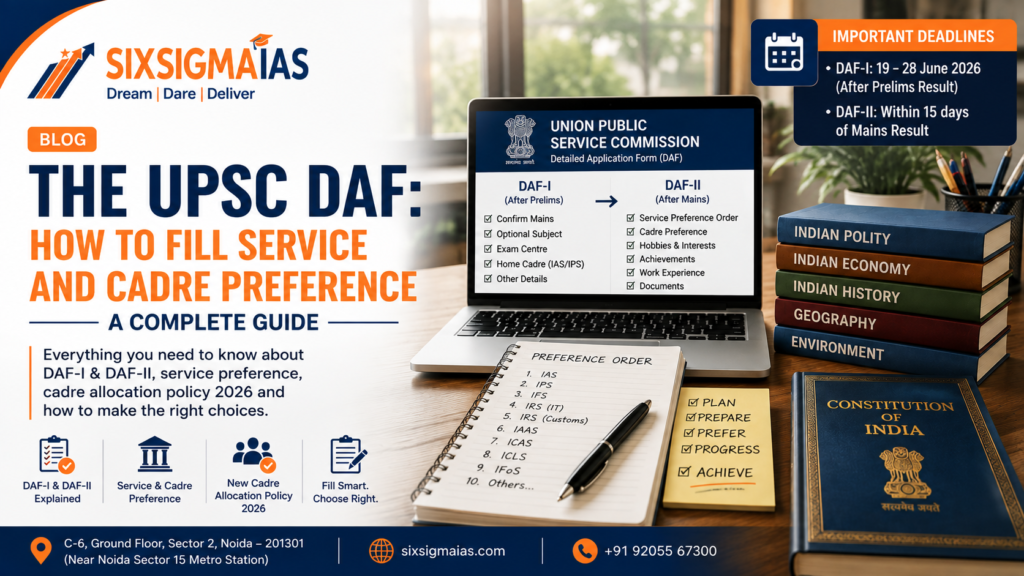
The UPSC DAF: How to Fill Service and Cadre Preference
Most aspirants spend two years preparing for the examination and forty minutes filling the form that decides where they will live for the next thirty years.
The Detailed Application Form is treated as an administrative chore. It is not. It does two things that nothing else in the process does: it supplies the board with almost every question you will be asked in the Personality Test, and it fixes the service and the state you will spend a career in.
This guide sets out what each stage of the UPSC DAF actually collects, how service and cadre preference genuinely work, and — the part most content online currently gets wrong — the new cadre allocation policy that takes effect from CSE 2026, replacing the five-zone system that has been in place since 2017.
First, the deadline that ends cycles
Before any strategy, the administrative fact that disqualifies people every year.
The DAF is not optional and its window does not move. Under the rules introduced for CSE 2026, candidates must log in and submit within roughly ten days of the Prelims result for DAF-I, and within fifteen days of the Mains result for DAF-II.
For the 2026 cycle, the DAF-I window ran from 19 to 28 June 2026, following the Prelims result on 15 June.
UPSC’s position is unambiguous: you must log in and submit even if nothing needs changing, because your Mains e-Admit Card cannot be generated without a submitted DAF. There is no extension and no appeal. A candidate who clears the Prelims on merit and misses this window does not sit the Mains.
Submit on day one of the window. Portal load is heaviest at the close, and there is no mechanism to rescue you.
DAF-I and DAF-II: what each one actually collects
These are confused constantly, including by sources that ought to know better. Several coaching sites state that full service preferences are collected in DAF-I. That is not quite right, and the distinction matters.
DAF-I — after the Prelims result, before the Mains
Largely a confirmation and logistics form. Much of it is read-only, carried over from your original application: personal details, education, Prelims details.
What you actually decide here:
- Confirmationthat you will sit the Mains
- Optional subjectfor Papers VI and VII
- Indian language paperfor the qualifying section
- Mains examination centre
- Disability-related provisionswhere applicable — scribe, larger font, compensatory time
- Home cadre indication for IAS and IPS— this one matters enormously, and is explained below
- Fee paymentwhere applicable
DAF-II — after the Mains result, before the Personality Test
This is the substantive one. It collects:
- Your full service preference order, across all services offered that year
- Cadre preferencesfor IAS, IPS and IFoS
- Hobbies and interests
- Achievements, prizes, positions of responsibility
- Work experience
- Supporting documentsfor verification
DAF-II is the document your interview board reads. Everything in it is fair game.
One caution. UPSC rebuilt its application architecture for CSE 2026 into a four-module system, and the exact fields have moved between stages before. Read the instructions on the live form for your own cycle rather than relying on any blog — including this one — for which field sits where.
The home cadre field in DAF-I, and the trap inside it
This deserves its own section because it is small, easy to skim past, and irreversible.
Under the cadre allocation framework, you are eligible for your home state as an insider only if you positively indicate that you want it. The 2026 policy retains this: candidates may be allotted their home state cadre, but only if they clearly indicate their willingness.
Under the previous five-zone policy the requirement was stricter still — to be considered for your home cadre against an insider vacancy, you had to give first preference both to the zone containing it and to the cadre itself, failing which you would not be considered for your home cadre at all.
The practical point survives the policy change: an insider slot is not something that happens to you by default. If you want your home state and do not say so in the prescribed manner, you are simply not in that queue.
Equally, if you positively do not want your home state, understand that you are giving up roughly a third of the seats in that cadre, since insider vacancies are the ones with the shorter queue.
What changed in January 2026: the new cadre allocation policy
This is the most important thing in this post, and the thing most UPSC cadre preference content on the internet has not caught up with.
In January 2026, the Department of Personnel and Training issued a new Cadre Allocation Policy, expressly in supersession of the existing one, taking effect with the Civil Services Examination 2026 and the Indian Forest Service Examination 2026.
What was abolished
The five-zone system, introduced in 2017, under which the state and joint cadres were divided into five geographical zones. Candidates ranked the zones in order, then picked one cadre from each zone in that order, and so on in rounds.
If you are reading a guide that tells you to rank Zone-I through Zone-V, it is describing a policy that no longer applies to you.
What replaced it
All state and joint cadres have been arranged in alphabetical order and divided into four groups.
Group-I, as reported, comprises AGMUT (the Arunachal Pradesh–Goa–Mizoram and Union Territories cadre), Andhra Pradesh, Assam-Meghalaya, Bihar and Chhattisgarh.
We have deliberately not reproduced the composition of Groups II, III and IV, because we could not source them from the order itself and we would rather publish nothing than publish a guess. Download the DoPT Office Memorandum from dopt.gov.in for the complete grouping before you fill your form. Do not rely on any coaching site’s reconstruction, including ours.
How allocation now works
The mechanism, in outline:
Step 1 — Vacancies. Determined on the basis of the cadre gap as on 1 January following the examination year, with states required to send their requirements by 31 January. Vacancies are broken into UR, SC, ST, OBC, and insider and outsider components.
Step 2 — Insider allocation. Candidates who have indicated willingness are considered for their home cadre, in merit order, against insider vacancies.
Step 3 — Outsider allocation. The remaining candidates are allotted through a rotational roster that cycles through the four groups — Group I, then II, then III, then IV, and round again. The order in which the groups are taken rotates each year: the group that goes first in one year moves to the bottom in the next.
Step 4 — The exchange mechanism. If the roster would allot a candidate their own home cadre as an outsider, the allocation is exchanged with the adjacent candidate on the list, so that the insider–outsider balance is preserved.
Throughout: the 1:2 insider–outsider ratio is retained. Roughly one officer in three in any cadre is from that state; the other two are not. This is the national-integration principle that has driven cadre policy since 2017, and it has not changed.
PwBD candidates receive strengthened protection under the new policy, including the possibility of an additional vacancy being created to accommodate a candidate in a preferred non-home cadre.
What this means when you actually fill the form
Three practical implications.
Rank every cadre, and rank it honestly. The roster is mechanical. There is no advantage in strategic under-ranking, and a truncated or careless list means the system fills your later slots without your input.
Geographic clustering no longer helps you. The point of both the 2017 and 2026 policies is to prevent candidates from stacking their own region. The four-group rotation does this structurally.
Your rank still determines almost everything. Preferences operate within what your rank and category make available. A realistic assessment of your likely rank band should shape how much thought you give to the top of your list versus the middle of it.
Service preference: the part where most people misjudge themselves
Before strategy, one number for perspective. Of the 933 vacancies notified for CSE 2026, only a small proportion are IAS — in the 2025 cycle, 180 of 1,087 vacancies were IAS.
The examination fills roughly 24 different services. Alongside the IAS, IPS and the Indian Foreign Service, these include the Indian Audit and Accounts Service, both branches of the Indian Revenue Service — Income Tax, and Customs and Indirect Taxes — the Indian Civil Accounts Service, Indian Corporate Law Service, Indian Defence Accounts Service, Indian Defence Estates Service, Indian Information Service, Indian Postal Service, Indian Railway Management Service, Indian Trade Service, and a set of Group B services including DANICS, DANIPS, the Pondicherry services and the AFHQ Civil Service.
The exact list changes between cycles as services are created, merged or restructured. Use the list in your own year’s notification, not a list from a blog.
Four principles for ordering them.
- Do not undervalue yourself.A recurring error: candidates place services they think they can “safely get” above services they actually want, as insurance. Allocation does not work that way. You are considered in merit order down your own list — placing something lower does not improve your chance at it, it only forfeits everything above it. Rank by what you want.
- Rank by the work, not the acronym.Read what officers in each service actually do. The IRS deals in fiscal policy, enforcement, transfer pricing and international tax treaties. The IAAS sits at the heart of public audit. The IDAS handles defence finance. These are substantial, specialised careers, and several of them offer intellectual depth and subject mastery that generalist administration does not.
- Think about the shape of the life, not the first posting.Frequency of transfers, degree of political interface, scope for central deputation, opportunities for specialisation, postings abroad. A twenty-eight-year-old ranking services by prestige is choosing a life at fifty.
- Fill the whole list.Every service, ranked. An incomplete preference list does not signal seriousness about your top choice; it just removes your voice from the rest of the allocation.
If you have not yet thought about what these careers actually involve, our post on whether UPSC is worth it sets out the day-to-day reality and the compensation structure in some detail.
DAF-II is your interview script
The Personality Test carries 275 marks against 1,750 for the Mains — around 13% of the final aggregate, and enough to move you several hundred ranks.
Almost every question comes from the DAF. Your hometown and district. Your graduation subject. Your optional. Your employer, if you have one. Your hobbies. The name of your school. Even your surname.
The governing rule: never write anything you cannot talk about for three minutes.
- Be specific and be truthful. “Reading” invites the question you fear; “reading Indian political biographies” invites a conversation you can lead. If you write it, you will be asked about it, and a hobby claimed for effect and not pursued is visible within two questions.
- Your home district.Know its administrative structure, its major issues, its principal crops or industries, its notable people. Boards routinely open here.
- Positions of responsibility and achievements.Genuine ones only, and be ready to describe what you actually did.
- Work experience.Expect substantive questions about your sector, and be prepared to explain why you are leaving it.
- Your optional subject.Fair game, particularly where it touches governance.
- Your service preference order.“Why have you placed the IRS above the IPS?” is a standard question, and a candidate who cannot answer it has told the board they filled the form carelessly.
That last point is worth dwelling on. Your preference order is itself examinable. Having a coherent, honest reason for the shape of your list is part of interview preparation, not separate from it.
The common mistakes
Filling it in the last two days. The window is ten days and you will spend all of it revising. Decide preferences before results day.
Inconsistency with your documents. Names, dates of birth and qualifications must match your certificates exactly. Mismatches surface at verification, when there is no time to fix them.
Claiming hobbies for effect. Transparent, and it costs marks.
Assuming preferences can be revised. They cannot. Once submitted, service preferences are final.
Deciding alone. Nearly everyone fills this form having never had a serious conversation with anyone who has actually served in the services they are ranking.
Using last year’s guidance. Particularly acute this cycle, given the change in cadre policy.
How to actually decide
A workable process, done in the months before you need it rather than during the window.
Read the official material first. The DoPT cadre allocation OM, and the service profiles in the notification. Primary sources, not summaries.
Talk to serving or retired officers — plural, and from different services. This is the single highest-value thing you can do, and the hardest to arrange. A serving officer will tell you in twenty minutes what a fortnight of reading will not: what the work actually feels like, what the constraints are, which cadres are stretched, and what a posting in a particular state means for family life.
Write a one-line justification for every rank. All the services, all the cadres. If you cannot articulate why one sits above another, you have not decided — you have guessed. This also happens to be your interview preparation.
Then have someone stress-test it. Ideally someone who can ask “why?” about any line and knows whether your answer is realistic.
That last step is the specific reason mentorship from former civil servants matters at this stage rather than any other. At Six Sigma IAS Academy the mentorship is led by Dr. Shikha Darbari, a 1990-batch IRS officer, alongside other former civil servants — people who have spent careers inside these services and can tell you what the choice actually means rather than what the brochure says. For DAF and preference decisions, that is not a marketing point; it is the difference between an informed decision and a guess with thirty-year consequences.
Frequently Asked Questions
What is the difference between DAF-I and DAF-II? DAF-I is submitted after the Prelims result and before the Mains. It confirms your participation, locks your optional subject, language paper and Mains centre, and takes your home cadre indication for IAS and IPS. DAF-II is submitted after the Mains result and before the Personality Test, and collects your full service preference order, cadre preferences, hobbies, achievements and work experience. DAF-I serves the Mains; DAF-II serves the interview.
What happens if I miss the DAF deadline? You cannot sit the examination stage that follows. The e-Admit Card is not generated without a submitted DAF, no extension is granted, and clearing the previous stage on merit makes no difference. UPSC requires every shortlisted candidate to log in and submit within the window even if no information needs changing.
Has the UPSC cadre allocation policy changed? Yes. In January 2026 the DoPT issued a new Cadre Allocation Policy in supersession of the earlier one, effective from CSE 2026 and IFoS 2026. The five-zone system introduced in 2017 has been abolished and replaced by four alphabetical groups of state and joint cadres, with outsider allocation running on a rotational roster that cycles through the four groups, and the group order rotating annually. The 1:2 insider–outsider ratio is retained. Verify the full group composition from the DoPT order before filling your form.
Will I get my home state cadre? Only if you positively indicate willingness, and only if your rank and category reach the insider vacancies for that cadre. Roughly one in three officers in any cadre is an insider; the rest are allotted from elsewhere. If you do not indicate willingness in the prescribed manner, you are not considered for your home cadre at all.
Can I change my service preference after submitting the DAF? No. Preferences are final once submitted. This is why the decision should be made in the months before the window opens, not during it.
How much does the DAF affect my interview? Substantially. The Personality Test carries 275 marks, and the overwhelming majority of questions are drawn from the DAF — your hometown, education, optional subject, work experience, hobbies and your service preference order. Boards frequently ask candidates to justify why they ranked one service above another.
Six Sigma IAS Academy C-6, Ground Floor, Sector 2, Noida – 201301 (near Noida Sector 15 Metro Station) Visit sixsigmaias.com to talk through your service and cadre preferences with mentors who have served in these very services.