

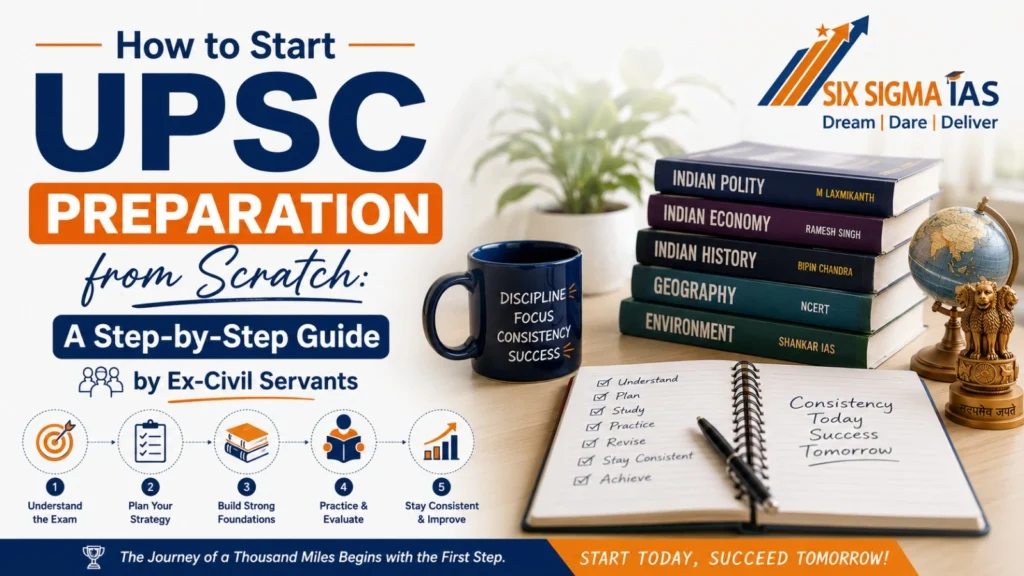
How to Start UPSC Preparation from Scratch: A Step-by-Step Guide by Ex-Civil Servants
UPSC Preparation begins with understanding that success is not about studying harder it’s about studying smarter. If you’re starting from scratch, the journey may seem challenging, but with the right strategy, consistency, and guidance, clearing the UPSC Civil Services Examination is an achievable goal.
Welcome! As former civil servants who have walked this exact path, we know firsthand how daunting the journey of UPSC preparation can seem from day one. The UPSC Civil Services Examination isn’t just a test of knowledge; it’s a test of endurance, strategy, and mental fortitude. When you are standing at the starting line, the sheer volume of the syllabus can feel overwhelming.
Instead of jumping blindly into a mountain of books, you need a systematic approach. Here is the blueprint we recommend for building your UPSC preparation from the ground up.
The biggest mistake beginners make in their UPSC preparation is trying to read everything all at once. The first few months should be about establishing a routine and understanding the landscape of the exam.
Decode the Syllabus and Exam Pattern: Do not buy a single book until you have done this
Print a hard copy of the UPSC syllabus for both Prelims and Mains. Read it every single day until you have it memorized. The syllabus is your only true guide. it tells you exactly what to read in the newspaper and which chapters to skip in heavy textbooks. Understand the three stages:
- Prelims: Two objective papers (General Studies and CSAT). It is purely a screening test.
- Mains: Nine descriptive papers (including Essay, General Studies I-IV, and two Optional papers). This is where your rank is decided.
- Personality Test (Interview): An assessment of your overall suitability for an administrative career.
- Analyze Previous Year Questions (PYQs): The syllabus tells you what to read; PYQs tell you how to read it.
Before diving into standard texts, spend your first week going through the last 5 to 7 years of Prelims and Mains question papers. You aren’t trying to solve them yet; you are training your brain to anticipate the type of questions the Commission asks. When you eventually read a newspaper or NCERT, having PYQs in the back of your mind helps you instinctively filter out the noise and focus on what is truly relevant for your UPSC preparation.
Build the Base with NCERTs: Class 6 to 12 textbooks are non-negotiable
Before moving to advanced reference books like M. Laxmikanth for Polity or Spectrum for Modern History, read the basic NCERTs. They simplify complex concepts and build a rock-solid foundation.
- History & Geography: Read from Class 6 to 12.
- Polity & Economy: Focus on Class 9 to 12.
- Science: Focus on Class 6 to 10 for basic everyday science.
- Start a Daily Newspaper Habit: Choose one paper and stick to it
Current affairs are the lifeblood of UPSC preparation. Pick either The Hindu or The Indian Express. In the beginning, reading the paper might take you three hours that is completely normal. Focus on the editorial pages, national news, and international relations. Skip local politics, sports, and entertainment. Correlate every news item you read back to a specific line in your printed syllabus and the PYQs you just analyzed.
Select Your Optional Subject Strategically: This decision can make or break your final rank
Your Optional subject accounts for 500 marks in the Mains exam. Do not choose a subject just because it is “scoring” or popular this year. Choose it based on:-
- Your genuine interest in the subject.
- Your academic background.
- The availability of study material and good mentorship.
- Its overlap with the General Studies syllabus.
Integrate Answer Writing and Mock Tests: Knowledge is useless if you cannot articulate it in 7 minutes
Once you have completed a basic reading of the core subjects, start practicing answer writing, a crucial phase of UPSC preparation. Use the PYQs you analyzed in Step 2 as your primary source of practice questions. The Mains exam requires you to write around 4,000 words in three hours. For Prelims, start taking weekly mock tests to build your elimination skills and time management.
- Revise and Test Relentlessly: Revision is the core of retention Schedule revision weekly, monthly, and intensively before each exam. Begin mock tests a few months before each stage, and analyse every one thoroughly. The learning is in the analysis, not the score.
- Respect the Marathon: Burnout ends more journeys than lack of ability does Sleep well,move your body, take a real break each week, and stay off the comparison trap. Burnout ends more UPSC preparation journeys than lack of ability does. Your only competition is the syllabus and yesterday’s version of yourself.
A Note on Mindset
Consistency will always beat intensity. Studying for 14 hours one day and then burning out for three days is a recipe for failure in UPSC preparation. Aim for 9 to 10 hours of highly focused, distraction-free study every day. Take breaks, maintain your physical health, and protect your mental space.
At Six Sigma IAS Academy, our goal is to bridge the gap between hard work and the right strategy. You bring the dedication; we will provide the direction.