

UPPSC vs UPSC: Key Differences and Can You Prepare for Both Together?
For thousands of aspirants in Uttar Pradesh, the civil services dream comes with an early and important decision: should you target the UPSC Civil Services Examination, the UPPSC PCS examination, or both? The two are often mentioned in the same breath, and their syllabi overlap heavily, yet they differ in scale, structure, and strategy in ways that can shape how you plan your entire preparation. This guide breaks down the UPPSC vs UPSC comparison in full and answers the question every serious aspirant eventually asks: can you realistically prepare for both together?
UPPSC vs UPSC: A Quick Overview
The UPSC (Union Public Service Commission) conducts the Civil Services Examination to recruit officers for all-India and central services, the IAS, IPS, IFS, IRS, and others with postings anywhere in the country. The UPPSC (Uttar Pradesh Public Service Commission) conducts the PCS (Provincial Civil Services) examination to recruit officers for state-level posts within Uttar Pradesh, such as Sub-Divisional Magistrate (SDM), Deputy Superintendent of Police (DSP), Block Development Officer (BDO), and Tehsildar.
Both follow the same three-stage architecture: Preliminary, Mains, and Interview, which is a large part of why preparing for both at once is even feasible. But within that shared skeleton, the details diverge.
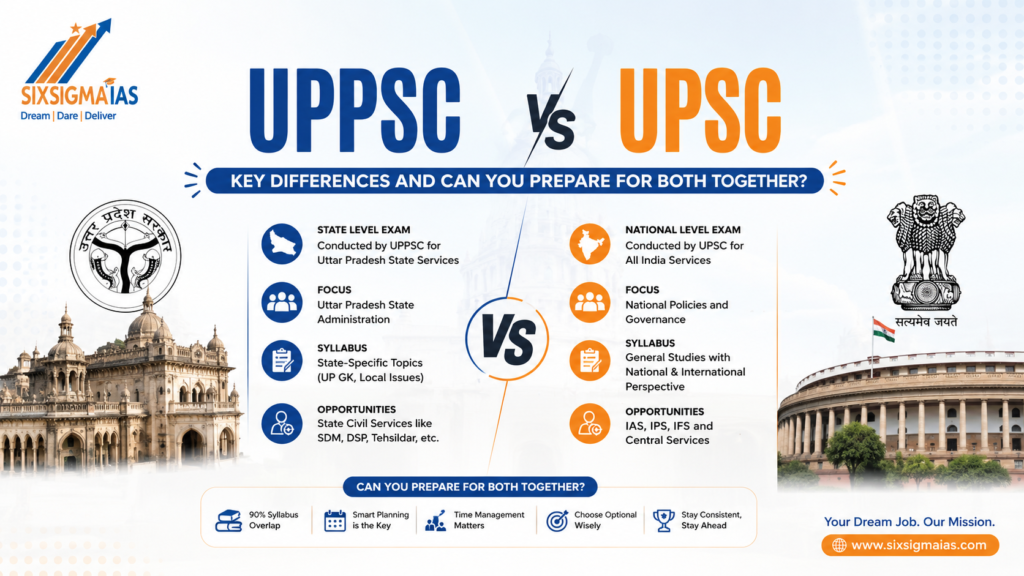
Key Differences Between UPSC and UPPSC
Here is the UPPSC vs UPSC comparison at a glance:
Feature | UPSC Civil Services (CSE) | UPPSC – PCS |
Conducting level | National / all-India | State (Uttar Pradesh) |
Key posts | IAS, IPS, IFS, IRS & other central services | SDM, DSP, BDO, Tehsildar & other UP state posts |
Stages | Prelims → Mains → Interview | Prelims → Mains → Interview |
Prelims | GS Paper I (merit) + CSAT (qualifying, 33%) | GS Paper I (merit) + CSAT (qualifying, 33%) |
Mains papers | 9 papers | 8 papers |
Optional subject | Yes two papers (500 marks) | No replaced by UP-specific GS V & VI |
Language papers | Qualifying Indian language + English | Compulsory General Hindi (counts in the total) |
Merit-deciding marks | 1,750 (Mains) + 275 (Interview) = 2,025 | 1,500 (Mains) + 100 (Interview) = 1,600 |
UP-specific weightage | Minimal | Heavy (GS V & VI + UP current affairs) |
Age limit (general) | 21–32 years | 21–40 years |
Attempts (general) | 6 | No fixed limit |
Domicile | Not required | Required for reservation benefits |
Beyond the table, a few points in the UPPSC vs UPSC comparison matter more than the rest.
The optional subject: this is now the single biggest structural difference. The UPSC Mains still includes two optional-subject papers worth 500 marks, and choosing and mastering an optional is a major part of UPSC preparation. UPPSC, on the other hand, has removed optional subjects entirely and replaced them with two UP-specific General Studies papers, GS V and GS VI. For a candidate preparing for both, this means the optional is UPSC-only work that carries no direct value for UPPSC.
UP-specific content: In place of the optional, UPPSC loads heavily on Uttar Pradesh: its history, geography, polity, economy, art, culture, schemes, and current affairs concentrated in GS Papers V and VI. This UP-specific block is largely irrelevant to UPSC but decisive for UPPSC, and it is the area where focused preparation pays off most.
Language papers: UPSC requires a qualifying Indian-language paper and a qualifying English paper, neither counted in the final merit. UPPSC instead has a compulsory General Hindi paper that carries weight in the Mains total and allows answers in Hindi or English throughout. Comfort with Hindi is therefore a genuine advantage in UPPSC.
Marks and scale: In UPSC, merit is decided by 1,750 Mains marks plus a 275-mark interview. In UPPSC, it is 1,500 Mains marks plus a 100-mark interview, so the personality test carries proportionally less weight in UPPSC.
Eligibility: UPSC is stricter on age and attempts, generally 21 to 32 years and six attempts for the general category, with relaxations. UPPSC is more generous, with a higher upper age limit (up to around 40 for the general category) and no fixed cap on the number of attempts, though Uttar Pradesh domicile is required to claim reservation benefits. (Always confirm exact age and relaxation rules against the current notification.)
Competition: Both are fiercely competitive, but UPSC draws a national pool for a few hundred vacancies, while UPPSC draws a very large state pool, often several lakh applicants for its posts. The character of the competition differs even where the intensity is comparable.
How Much Do the Syllabi Actually Overlap?
The encouraging news for anyone considering both is that the common ground is substantial, and understanding this overlap is central to the UPPSC vs UPSC decision. At the Prelims stage, both exams test General Studies history, geography, polity, economy, environment, science, and current affairs through an objective paper, alongside a qualifying CSAT paper. At the Mains stage, UPPSC’s GS Papers I to IV map closely onto UPSC’s GS Papers I to IV in subject matter, and both now demand descriptive, analytical answer writing rather than rote reproduction. An Essay paper features in both. In short, the core knowledge base, perhaps 60 to 70 per cent of the effort, serves both exams.
What does not overlap is the exam-specific layer: the optional and the qualifying language papers for UPSC, and the UP-specific GS V and VI plus General Hindi for UPPSC.
Can You Prepare for UPSC and UPPSC Together?
Yes, and for a UP-based aspirant, doing so is often a smart, efficient strategy rather than a distraction. The key is to build deliberately, in layers.
Build the common GS core once: Treat the shared General Studies foundation Prelims GS and Mains GS I to IV as a single body of preparation that feeds both exams. This is where most of your time should go, and every hour spent here counts twice.
Add the UP-specific layer for UPPSC: On top of the common core, prepare Uttar Pradesh’s history, polity, economy, geography, culture, schemes, and current affairs for GS V and VI, and give General Hindi its due. Because this content is finite and fairly predictable, targeted preparation here is one of the highest-return investments a UPPSC aspirant can make.
Retain the UPSC-only components: Keep your optional subject and the qualifying language papers on track for UPSC, treating them as additional, exam-specific work rather than shared effort.
Practise answer writing once, use it twice: Since both Mains are now descriptive, structured answer-writing practice transfers directly between the two exams. The skill you build for one sharpens your performance in the other.
Mind the calendar and your focus: The two exams run on separate cycles, and their Prelims and Mains dates can fall inconveniently close. Plan the year so that one exam’s intensive phase does not cannibalise the other’s, and be honest about whether dual preparation is sharpening or diluting your focus. This is exactly where structured guidance helps: a good mentor or programme can sequence your preparation, keep the UP-specific and optional workloads from colliding, and hold you accountable across both timelines.
Which One Should You Target?
The UPPSC vs UPSC choice ultimately comes down to your goals. If your single ambition is an all-India service like the IAS or IPS, UPSC is the target, and UPPSC can serve as a strong parallel option or backup that uses much of the same preparation. If a respected, senior state-administrative career in Uttar Pradesh is itself the aim and for many aspirants it genuinely is UPPSC deserves to be a primary target in its own right, not merely a consolation. For a large number of UP aspirants, the honest answer is both: prepare the common core seriously, layer on the exam-specific portions, and give yourself two shots at a civil services career from largely overlapping effort.
Conclusion
The UPPSC vs UPSC question is less about which exam is “better” and more about matching the exam to your goals and recognising how much of the work is shared. The two differ meaningfully in the optional subject, UP-specific content, language requirements, scale, and eligibility, but they rest on a common General Studies foundation and an identical three-stage structure. For the well-organised aspirant, that overlap makes a combined preparation not only possible but strategically wise.
At Six Sigma IAS Academy, we help aspirants navigate exactly this decision, building the common GS core, layering in the UP-specific preparation that UPPSC rewards, and mentoring candidates one-on-one across both timelines. Led by Dr Shikha Darbari, a 1990-batch IRS officer, and delivered by toppers and ex-civil servants, we aim to make a dual UPSC–UPPSC attempt a structured plan rather than a gamble
Frequently Asked Questions (FAQs)
Not identical, but heavily overlapping. The General Studies core for both Prelims and Mains GS I to IV is largely common. The key differences in the UPPSC vs UPSC comparison are UPPSC's UP-specific GS V and VI papers and General Hindi, versus UPSC's optional subject and qualifying language papers.
Yes. Because roughly two-thirds of the effort is shared, many aspirants prepare for both by building the common GS foundation once and then adding each exam's specific portions. The main challenge is managing overlapping exam calendars, which is where a structured plan and mentorship help.
Neither is "easy," but UPPSC is generally considered more accessible on eligibility a higher upper age limit and no cap on attempts and its UP-specific, finite content can be scored well with focused preparation. UPSC has a wider, deeper syllabus and a national competition for fewer seats.
No. UPPSC has removed optional subjects and replaced them with two UP-specific General Studies papers. UPSC still retains two optional-subject papers. This is one of the most important differences to factor into your strategy.