

India’s SHANTI Framework: Strengthening Security in the Bay of Bengal and the Maritime Commons
Key Highlights
- Launch of SHANTI:External Affairs Minister Jaishankar unveiled the SHANTI (Securing Holistic Advancement through Norms, Trust and Integrity) framework while announcing India’s candidature for the UNSC 2028–29 term. It represents India’s latest maritime governance initiative.
- Evolution of Maritime Strategy:Building upon SAGAR (2015) and MAHASAGAR (2025), SHANTI shifts India’s approach from strategic outreach to rule-based cooperation, institution-building, and norm creation in maritime affairs.
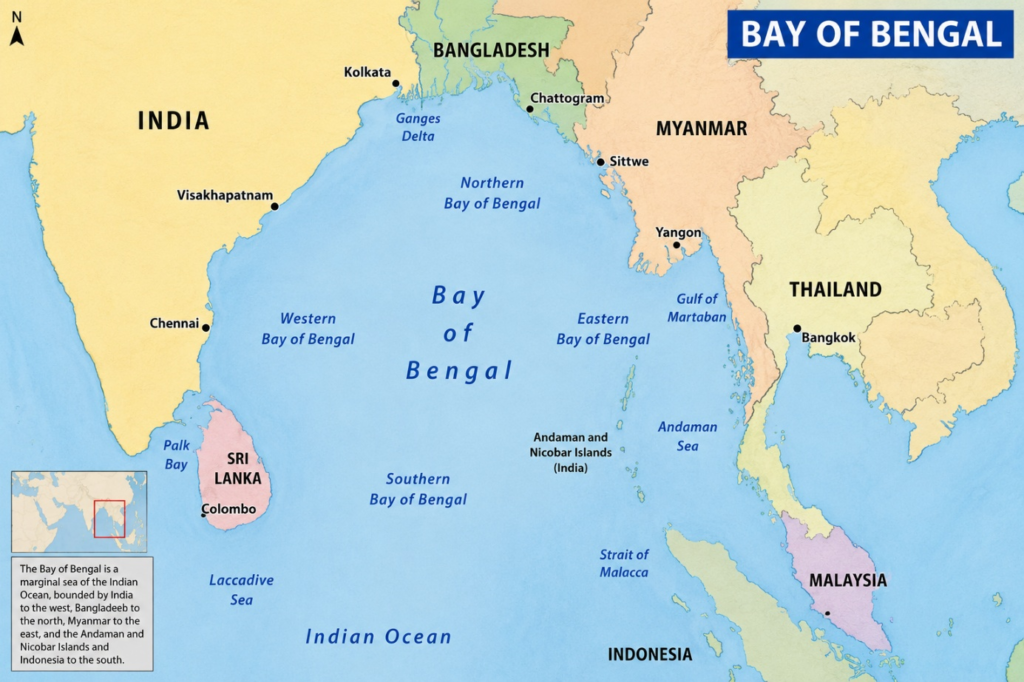
- Strategic Importance of the Bay of Bengal:The Bay of Bengal connects India’s Act East Policy with ASEAN, supports major global energy routes, and is central to addressing regional geopolitical challenges, including China’s growing maritime presence.
- Addressing Emerging Threats:The framework promotes collective action against climate-induced disasters, illegal fishing, cyber threats, and supply chain disruptions through demand-driven regional cooperation.
- BIMSTEC Implementation:At the July 2026 BIMSTEC National Security Advisers’ Meeting, member countries agreed to strengthen maritime law enforcement, Humanitarian Assistance and Disaster Relief (HADR), and conduct a joint maritime security exercise.
Essential Definitions
- SHANTI Framework:India’s normative maritime policy promoting trust, integrity, and rules-based governance of shared maritime spaces.
- SAGAR:Security and Growth for All in the Region, launched in 2015, aims to enhance security, economic cooperation, and sustainable development in the Indian Ocean Region.
- Blue Economy:Sustainable use of ocean resources for economic growth, livelihood generation, and marine ecosystem conservation.
Legal Framework
- Article 51:Encourages international peace, respect for international law, and multilateral cooperation.
- UNCLOS:Provides the legal basis for a rules-based maritime order, freedom of navigation, and maritime jurisdiction.
- BIMSTEC Charter:Institutional framework for regional cooperation, connectivity, and maritime security.
Conclusion
The SHANTI Framework marks a shift from traditional maritime security to proactive governance of shared maritime commons. By strengthening regional trust, collective resilience, and institutional cooperation in the Bay of Bengal, India seeks to promote a stable, secure, and rules-based Indo-Pacific.