
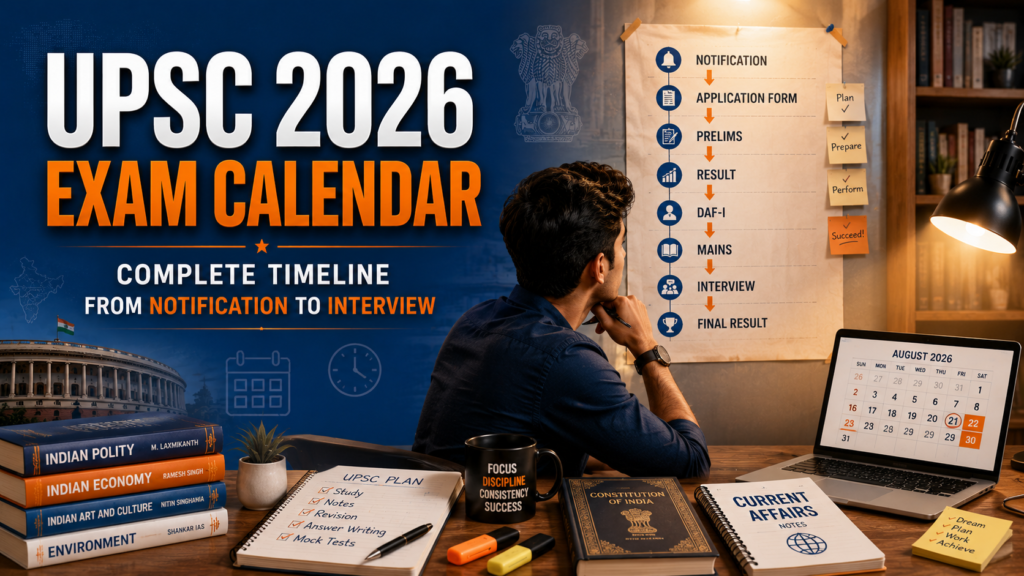
UPSC 2026 Exam Calendar: Complete Timeline from Notification to Interview
Most aspirants treat the annual calendar as a poster — glance at the Prelims date, screenshot it, move on. That is a mistake, because the dates that actually decide outcomes are rarely the exam dates. They are the ten-day windows in which a form must be submitted, the gap between two stages that determines how you sequence your syllabus, and the deadline that quietly disqualifies people who cleared Prelims on merit.
This post lays out the complete UPSC 2026 calendar as it has actually unfolded — not as it was originally projected — along with the confirmed dates for the 2027 cycle, and a method for turning either one into a working study plan.
If you are reading this in the second half of 2026, one of two things is true. Either you are among the 13,343 candidates sitting the Mains this August, in which case the sections below are your operational checklist. Or you are not, in which case the CSE 2027 timeline further down is the one that concerns you — and you have already lost some of the runway.
The UPSC 2026 calendar at a glance
Stage | Date |
Annual Calendar 2026 published | 15 May 2025 |
Notification released | 4 February 2026 |
Application window | 4 February – 24 February 2026 (extended to 27 February) |
Vacancies notified | 933 (CSE) + 80 (Indian Forest Service) |
Prelims e-Admit Card | 15 May 2026 |
Preliminary Examination | 24 May 2026 (Sunday) |
Prelims result | 15 June 2026 |
Detailed Application Form – I (DAF-I) | 19 – 28 June 2026 |
Mains e-Admit Card | First week of August 2026 |
Main Examination | 21, 22, 23, 29 and 30 August 2026 |
Mains result | Expected November – December 2026 |
DAF-II | Within the window notified after the Mains result |
Personality Test (Interview) | Expected January – March 2027 |
Final result | Expected March – April 2027 |
UPSC attaches a standing caveat to every calendar it publishes: the dates of notification, commencement and duration of examinations are liable to alteration if circumstances warrant. Treat the table above as a planning instrument and upsc.gov.in as the only authority.
That caveat is not boilerplate, as the next section shows.
Stage 1: Notification and application — and the lesson buried in it
The UPSC 2026 calendar, published on 15 May 2025, projected the notification for 14 January 2026 with applications closing on 3 February.
That is not what happened. The notification was postponed and finally released on 4 February 2026, with the application window running to 24 February, subsequently extended to 27 February.
There is a genuine lesson here, and it is the most useful thing in this entire post: the annual calendar is a planning document, not a guarantee. The exam dates in it have historically been reliable — Prelims and Mains have held. The notification and application dates are the ones that move.
The practical implication: never wait for the notification to begin preparing, and never wait for the last week to apply. Aspirants who assume the deadline will be extended eventually meet a year in which it isn’t.
Alongside the 2026 notification, UPSC introduced a substantially rebuilt application system:
- A four-module online applicationstructure, built around a permanent Universal Registration Number (URN)valid across UPSC examinations
- Live photo captureduring the application — previously uploaded photographs are not accepted
- Aadhaar-based verification encouraged but not mandatory; Voter ID, PAN, Passport and Driving Licence remain acceptable
- Face authentication at examination centresto prevent impersonation
- The window for representations against question papers reduced from seven days to five
- Revised rules on re-attempts for candidates already allocated a service
Complete your One Time Registration well before the notification for your cycle. It is free, takes fifteen minutes, and removes the single most common cause of last-week panic.
Stage 2: The Preliminary Examination
The Prelims was held on 24 May 2026 across 2,072 examination venues nationwide, with the e-Admit Card released on 15 May.
The participation figures are worth sitting with. 8,19,732 candidates applied. Approximately 5.49 lakh actually appeared — about 67%, notably higher than the 61% turnout in the 2025 cycle. Roughly one in three registered candidates did not sit the paper.
The result was declared on 15 June 2026, three weeks after the exam. 13,343 candidates qualified for the Main Examination.
Two structural facts about this stage that every part of your UPSC schedule should be built around:
Only GS Paper I counts. CSAT (Paper II) is purely qualifying at 33%. It determines nothing about your rank and everything about whether you have a rank at all. Candidates from non-mathematical backgrounds who neglect CSAT are eliminated by a paper they were not required to score in.
The gap to Mains is fixed and short. From 24 May to 21 August is under three months, and the DAF window eats the first ten days of it. Nobody has ever built Mains preparation from scratch in that gap. Answer writing and optional-subject preparation must be substantially complete before you sit the Prelims.
Stage 3: DAF-I — the deadline that disqualifies
Between 19 and 28 June 2026, every candidate who cleared the Prelims had to log in and submit the Detailed Application Form.
This is the most under-publicised item in the entire UPSC 2026 calendar, and the one that ends the most cycles unnecessarily.
The DAF is where you declare service preferences, cadre preferences, educational background, employment history and your optional subject. UPSC’s position is unambiguous: candidates must log in and submit within the window even if nothing needs updating, because the Mains e-Admit Card cannot be generated without it. There is no extension and no appeal. A candidate who clears the Prelims on merit and misses this window simply does not sit the Mains.
Under the 2026 rules, the login requirement is tight at both stages — within roughly ten days of the Prelims result for DAF-I, and within fifteen days of the Mains result for DAF-II.
Two pieces of practical advice. First, submit on day one of the window, not day nine — portal load is heaviest at the close. Second, decide your service and cadre preferences before results day, not during it. The DAF window is ten days long and you will spend all of it revising for the Mains. Preference ordering deserves considered thought and a conversation with someone who has actually served in the services you are ranking.
Stage 4: The Main Examination — paper-wise schedule
The Civil Services (Main) Examination 2026 runs over five examination days across two weekends: 21, 22, 23, 29 and 30 August 2026.
Sessions are 9:00 AM – 12:00 Noon (forenoon) and 2:30 PM – 5:30 PM (afternoon).
Date | Day | Forenoon | Afternoon |
21 August 2026 | Friday | Essay | No paper |
22 August 2026 | Saturday | General Studies I | General Studies II |
23 August 2026 | Sunday | General Studies III | General Studies IV |
29 August 2026 | Saturday | Paper A – Indian Language (qualifying) | Paper B – English (qualifying) |
30 August 2026 | Sunday | Optional Paper I | Optional Paper II |
Nine papers in total: seven counted for merit (Essay, GS I–IV, and both Optional papers, totalling 1,750 marks) and two qualifying language papers. The Personality Test adds 275 marks, taking the final aggregate to 2,025.
Three things this particular sequence tells you:
The Essay opens the exam, alone. There is no afternoon paper on 21 August. Whatever state you walk out of the Essay hall in shapes the four GS papers that follow immediately. Essay practice cannot be deferred to the final fortnight.
Four GS papers land back to back. GS I and II on the Saturday, GS III and IV on the Sunday. That is roughly 80 answers in 48 hours. This is a test of writing stamina as much as of knowledge, and the only way to build it is full-length timed papers, not topic-wise practice.
A six-day gap, then the language papers, then the Optional. The break after 23 August is your last revision window for the Optional — and it is short. Candidates who arrive at 30 August having not touched the Optional since Prelims lose 500 marks’ worth of ground.
The Mains e-Admit Card is expected in the first week of August 2026 from upsconline.nic.in and must be downloaded — no physical copies are issued.
Stage 5: Result, DAF-II, Personality Test and final result
The remainder of the 2026 cycle has not been dated by UPSC. What follows is projected from the pattern of the immediately preceding cycles, and should be treated as such.
- Mains result:expected November – December 2026. Roughly two to two-and-a-half times the number of vacancies are called for interview — 2,736 candidates in the 2025 cycle.
- DAF-II:submitted within the window notified after the Mains result. This is the document your interview board reads. Every line in it — your hobbies, your home district, your graduation subject, your service preferences — is fair material for questioning.
- Personality Test:conducted at UPSC’s Dholpur House, New Delhi, typically across January to March, carrying 275 marks.
- Final result:in the 2025 cycle, declared on 6 March 2026 — 958 candidates recommended against 1,087 vacancies, with a consolidated reserve list of 258. On that pattern, the CSE 2026 final result falls around March–April 2027.
Note what that means for the total arc: a candidate who applied in February 2026 receives a final result in roughly March 2027, and joins training some months after that. The Civil Services Examination is a fourteen-month process from application to result. Any personal plan built on “I’ll know by the end of the year” is mis-specified.
The CSE 2027 calendar — the one most readers should be planning against
UPSC released the Annual Calendar 2027 on 20 May 2026, covering 27 examinations. For Civil Services aspirants, the confirmed dates are:
Stage | Date |
CSE 2027 Notification | 13 January 2027 |
Last date to apply | 2 February 2027 |
Preliminary Examination | 23 May 2027 (Sunday) |
Main Examination | From 20 August 2027 (Friday), five days |
IFoS Prelims | 23 May 2027 (same paper as CSE Prelims) |
IFoS Mains | From 21 November 2027 (seven days) |
Other examinations on the 2027 calendar include Engineering Services Prelims on 31 January 2027, NDA & NA (I) and CDS (I) on 11 April 2027, NDA & NA (II) and CDS (II) on 19 September 2027, and the Combined Geo-Scientist Prelims on 10 January 2027 — the earliest examination of the year, with its notification due as early as 2 September 2026.
Two features of the 2027 timeline deserve attention:
The application window is 20 days. From 13 January to 2 February 2027. If your OTR is not already complete, do it now rather than in January.
The Prelims-to-Mains gap is 89 days. Identical in structure to 2026, and identically insufficient for anyone starting Mains preparation after the Prelims result.
If you are beginning preparation as you read this, 23 May 2027 is your date. That is a runway of roughly ten months — tight but entirely workable for a candidate who starts with a plan, and nowhere near enough for one who spends two months collecting books.
How to turn a calendar into a study plan
A date table is not a plan. Here is how to convert one.
Work backwards, never forwards. Fix the Prelims date first, then subtract: 45 days of pure revision and full-length mocks before it, 60 days before that for the second reading, and everything else lands in the first phase. What survives that subtraction is your actual available time, which is always less than you assumed.
Give current affairs a separate track. It does not fit into a subject-wise schedule because it never ends. Run it daily alongside the static syllabus, from the notification month right through to the interview.
Build the Optional in parallel, not sequentially. The 89-day Prelims-to-Mains gap in both cycles makes this non-negotiable. Aim to have completed the Optional syllabus at least once before you sit the Prelims.
Start answer writing early — very early. The single most common regret among repeat candidates is having treated answer writing as a post-Prelims activity. GS papers reward practised writers, and practice takes months.
Mark the administrative windows in a different colour. The DAF windows are the only dates on the whole UPSC timeline where missing a deadline ends your cycle outright, regardless of how well you performed.
This backward-planning discipline is exactly what structured mentorship exists to enforce. At Six Sigma IAS Academy, study planning is anchored to the official UPSC schedule and reviewed against it rather than against a generic syllabus, with mentorship from former civil servants — the academy is led by Dr. Shikha Darbari, a 1990-batch IRS officer. The advantage of guidance from someone who has served is sharpest at exactly the two points where the calendar bites: DAF preference ordering, and interview preparation.
Frequently Asked Questions
When is UPSC Mains 2026 and what is the paper-wise schedule? The Main Examination 2026 is held on 21, 22, 23, 29 and 30 August 2026. The Essay is on 21 August in the forenoon session only; General Studies I and II on 22 August; General Studies III and IV on 23 August; the qualifying Indian Language and English papers on 29 August; and both Optional papers on 30 August. Sessions run 9:00 AM–12:00 Noon and 2:30 PM–5:30 PM.
What are the confirmed UPSC 2027 exam dates? As per the Annual Calendar 2027 released on 20 May 2026: notification on 13 January 2027, applications closing 2 February 2027, Prelims on 23 May 2027, and Mains commencing 20 August 2027 for five days.
Are the dates in the UPSC 2026 calendar final? The examination dates have held, but the notification date did not — the calendar projected 14 January 2026 and the notification was actually released on 4 February 2026. UPSC’s own caveat states that dates are liable to alteration if circumstances warrant. Verify everything against upsc.gov.in.
What happens if I miss the DAF submission window? You cannot appear for the Main Examination, regardless of having qualified the Prelims. The e-Admit Card is not generated without a submitted DAF, and no extension is granted. UPSC requires every shortlisted candidate to log in and submit within the window even if no information needs changing.
Where do I download the official UPSC calendar? From upsc.gov.in — go to the Examination tab and then Calendar, where the last three years’ annual calendars are hosted as PDFs. Download it directly rather than relying on any third-party reproduction, including this one.
Knowing the dates is the easy part. Building a preparation schedule that actually reaches 23 May 2027 with the syllabus revised twice and thirty full-length papers written is the hard part — and it is where most aspirants lose the cycle before it starts.
Six Sigma IAS Academy C-6, Ground Floor, Sector 2, Noida – 201301 (near Noida Sector 15 Metro Station) Visit sixsigmaias.com to have our mentors build a backward-planned schedule around your target cycle.