
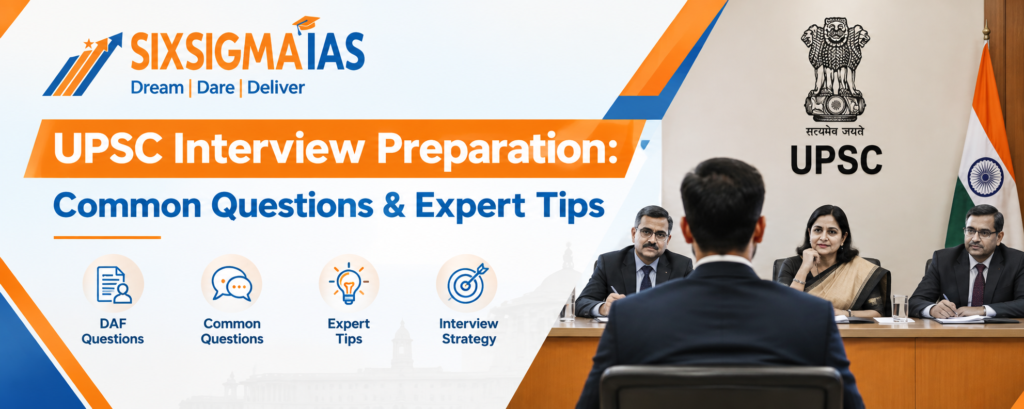
UPSC Interview Preparation: Common Questions and Expert Tips
If you wrote Mains in August, you are now in the oddest stretch of the whole examination. The papers are done. Nothing you do now will change a single mark in them. And the result is still some weeks away.
Most candidates spend this period in one of two ways. Some keep checking the UPSC website every evening. Others try not to think about the exam at all. We would suggest a third way: start your UPSC interview preparation now, slowly and without any pressure.
There is a practical reason for this. Once the Mains result comes out, you usually get only about a week to fill DAF-II, and then the interview schedule follows. Candidates who begin in September walk into that period with most of the groundwork already done. Those who wait tend to fill their DAF in a hurry and then spend weeks preparing to defend what they wrote in it.
Why 275 Marks Count for More Than They Seem To
On paper, the Personality Test is the smallest part of the Civil Services Examination. It carries 275 marks. The written Mains carries 1750. Together they make the final total of 2025.
But the numbers behave differently in practice. In the 2025 cycle, 2,736 candidates were called for interview and 958 were finally recommended. Many of the people waiting outside the board room had Mains scores within a few dozen marks of each other. Interview marks are far more spread out. A good interview and an ordinary one can easily be 40 or 50 marks apart, and when Mains scores are bunched together, that gap can move you by hundreds of ranks.
In most cases, then, the interview does not decide who is in the race. It decides where you finish, and very often, which service you get.
What the Board Is Actually Assessing
The UPSC notification is quite direct on this. The interview is not meant to test your knowledge again, because nine papers have already done that. The board is trying to judge whether you are suited to a career in public service.
The qualities the notification mentions include mental alertness, the ability to understand and assess new information, clear and logical expression, balance of judgement, range and depth of interests, the ability to work with people and lead them, and intellectual and moral integrity.
Go through that list slowly and you will notice that almost none of it is about facts. It is about how you think, how you speak, and how honest you are when you are under pressure.
One practical lesson follows from this. Saying “Sorry, Sir, I am not aware of that” costs you very little. Making up an answer can cost you a great deal, because the board is judging your honesty, your judgement and your clarity at the same moment.
How the interview works
Board | A Chairman, who is a Member of UPSC, and usually four other members |
Venue | Dholpur House, Shahjahan Road, New Delhi |
Duration | Generally between 20 and 35 minutes |
Marks | 275 |
Minimum qualifying marks | None. Whatever you score is added to your Mains total |
Who gets called | Roughly two to three times the number of vacancies |
What the board reads before you enter | Your Detailed Application Form (DAF) |
A word of caution on marks. UPSC does not publish an official average interview score. Analyses of recommended candidates suggest most scores fall somewhere between about 40 and 75 per cent of 275, with very few crossing 200. Treat any exact “average” you see online as an estimate from a limited sample.
Your DAF Is Your Syllabus
This is the most important idea in UPSC interview preparation, and it is the reason we don’t publish lists of “most asked questions”.
The board has your DAF in front of it. It has perhaps half an hour to form a view about you, so it naturally starts with what you have told it about yourself. Your birthplace, your school and college, your graduation subject, your optional, your job, your hobbies, your service preferences, and any gap in your education or career are all fair ground.
Here is a made-up example. Suppose a candidate’s DAF says the following: born in Bareilly; B.Tech in Electrical Engineering; two years with a software company in Pune; Sociology optional; hobbies are cricket and reading Hindi poetry. From these few lines alone, a board could reasonably ask:
- about Bareilly’s economy, its main problems and any recent news from the district
- why an electrical engineer moved into software, and then left it
- a basic question from electrical engineering, which many candidates have not looked at in years
- what exactly the candidate did at work, and what it taught them about how organisations function
- a sociological reading of some current issue
- who their favourite poet is, and a few lines they like
- something about how cricket is run in India, or about sports administration generally
Now do this with your own DAF, line by line. Write down every question you think a sensible, well-read person could ask. Then answer each one aloud. Answers that sound fine in your head often fall apart the first time you say them out loud.
If you have not yet filled DAF-II, read our guide on filling service and cadre preferences in the DAF first. Whatever you write in that form, you should be ready to explain in the interview.
The Kinds of Questions That Come Up
There is no fixed question bank, but the questions tend to fall into a few familiar types.
Questions about you
Why the civil services? Why this optional? Why did you leave a good job? What were you doing in the two years after graduation? These usually come early. The board has heard every standard answer many times over. What it is listening for is whether your answer fits with the rest of your DAF and sounds like your own.
Your home state and district
Expect questions on the administration, economy and problems of your district, and on anything that has been in the news from there. A candidate who can talk about the country but not about their own district gives a poor impression.
Your graduation subject and optional
The board will not test you at examination level, but it does expect you to remember the basics of a subject you studied for three or four years. Forgetting your own graduation subject is one of the most common and most avoidable failures in the room.
Work experience
If you have worked, this is often where the most detailed questions come from. What did you do, what went wrong, what would you change? Candidates who describe their job vaguely lose credibility quickly.
Current affairs and your opinion
What do you think about a particular policy, a court judgment or an international development? There is rarely a single right answer. What the board notices is whether your view is balanced, whether you can see the other side, and whether you can hold your position politely when someone disagrees with you.
Situations and ethics
“You are the District Magistrate and this happens. What will you do?” Answers that ignore the law, or avoid the dilemma altogether, do badly. Answers that recognise the competing pressures and then take a clear, practical decision do well.
Questions meant to test your composure
Sometimes a member will interrupt you, disagree sharply or look unconvinced. This is not personal. The board wants to see whether you stay calm, neither giving up your view at once nor becoming stubborn about it.
A Timeline From Now to Your Interview
This is how we would suggest a candidate who wrote Mains 2026 spreads out the work. The dates after the result are estimates based on the 2025 cycle; update them once UPSC announces the actual schedule.
Period | What to do |
September to the Mains result (expected around November–December 2026) | Keep it light. Read the newspaper for opinions, not just facts. Start a file on your district and home state. Revise the basics of your graduation subject. Note down what you genuinely do in your hobbies. |
Result day to the DAF-II deadline (usually about a week) | Fill DAF-II carefully and honestly. Keep a copy of exactly what you submit. |
After DAF-II until your interview | Build your personal DAF question list. Take three to five mock interviews. Cover the main current issues of the last six months. Practise speaking answers aloud every day. |
The last few days | No new material. Sleep properly. Do one calm dress rehearsal. Read that morning’s newspaper on the day of the interview. |
In the 2025 cycle, interviews ran until late February 2026 and the final result came on 6 March 2026. The 2026 cycle may follow a similar pattern, but no dates have been notified yet.
Mock Interviews: Take Some, Not Too Many
Mock interviews are the most useful part of interview preparation, and also the part candidates most often overdo.
A good mock shows you habits you cannot see yourself: repeating “basically” in every answer, drifting away from the question, speaking too long, looking at one member only, or getting defensive when contradicted. A panel will notice these within minutes.
The problem starts when candidates take ten or twelve mocks at different institutes. By the end, they have usually collected a set of polished answers and started delivering them like speeches. Real boards notice this at once, and it works against you.
Three to five mocks is a sensible number. Leave a few days between them so you can actually work on the feedback. And try to sit before at least one panel with people who have themselves served in government or conducted selection interviews. Their feedback tends to be about your suitability for the job, not just your body language.
At Six Sigma IAS Academy, our mock interview panels include former civil servants, and the programme is guided by Dr. Shikha Darbari, a 1990-batch IRS officer. What experienced officers bring to a mock is judgement. They can usually tell whether a candidate is nervous or simply underprepared, and they will tell you which one you came across as.
Things That Quietly Cost Marks
Memorised answers. They sound smooth but usually don’t fit the exact question asked, and the board can tell.
Bluffing. Admitting you don’t know something is a small loss. Inventing an answer is a large one.
Hobbies you don’t really follow. If it is on your DAF, you may get several minutes of questions on it. Only list what you can actually talk about.
Arguing. Holding a reasoned view is good. Refusing to accept a fair point is not.
Over-rehearsed manners. A fixed smile and a practised posture look artificial. Be polite and be yourself.
Service preferences that don’t match your answers. If your first choice is IAS but every answer you give is about tax policy, expect to be asked why.
Frequently Asked Questions
How many marks is the UPSC interview and is there a minimum qualifying score? The Personality Test carries 275 marks, which are added to your 1750 Mains marks for a final total of 2025. There is no minimum qualifying score for the interview, but every mark counts towards your rank.
What kind of questions are asked in the UPSC personality test? Most questions come from your own DAF: your background, education, optional, work experience, hobbies, home district and service preferences. The board also asks about current affairs, your opinions on issues, and situational or ethical problems. There is no fixed list, which is why DAF-based preparation matters more than any question bank for UPSC interview preparation.
How many mock interviews should I take? Three to five is usually enough, with a few days between each so you can act on the feedback. Taking too many tends to make answers sound rehearsed.
When should I start preparing for the UPSC interview? Start light preparation soon after your Mains papers, well before the result. Build your district notes, revise your graduation subject and read the newspaper for opinions. Intensive preparation and mock interviews can begin after the result and DAF-II.
Are questions asked from the optional subject? Sometimes, though not at the depth of the written paper. You should be able to explain why you chose it and discuss it sensibly. Questions on your graduation subject are often more searching.
Can a very good interview make up for a weak Mains score? Up to a point. A strong interview can lift your rank considerably, but with 1750 marks in Mains against 275 in the interview, your written score sets the range. In practice, the interview more often decides your service than whether you are selected.
Six Sigma IAS Academy C-6, Ground Floor, Sector 2, Noida – 201301 (near Noida Sector 15 Metro Station) Visit sixsigmaias.com to book a mock personality test with a panel of former civil servants, and to have your DAF reviewed before you face the board.