
How to Revise the UPSC Syllabus Without Feeling Overwhelmed
Almost every aspirant reaches a point where the problem is no longer reading. It is remembering.
You finished Polity in June. By September, Fundamental Duties feel vague and you cannot recall which Schedule deals with what. You have moved on to Economy, and meanwhile History is quietly slipping away. The pile of “things I have studied but will have to study again” keeps growing, and at some stage it starts to feel impossible.
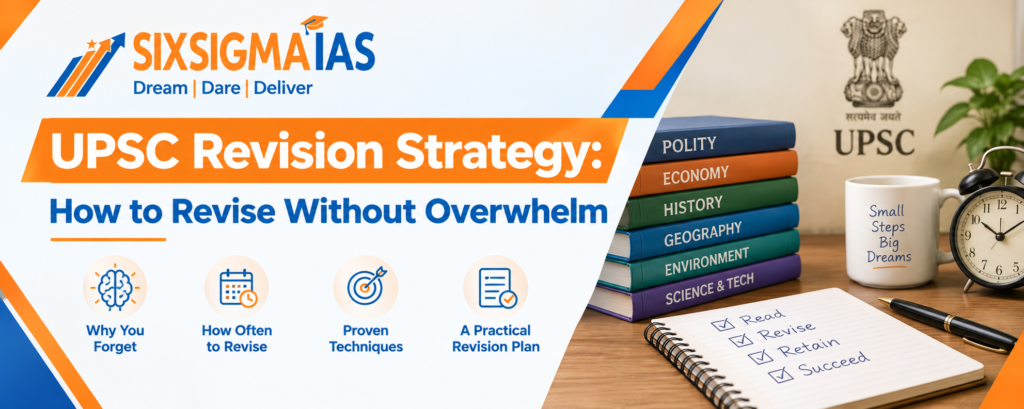
That feeling is common, and it is not a sign that you are weak at this. It usually means you have been reading steadily but have not yet built revision into your week. This post is about fixing that: why forgetting happens, how often you really need to revise, what methods work, and how to lay out a revision plan for the months left before Prelims 2027.
Why You Forget What You Studied
Forgetting is normal. Psychologists have known for more than a century that we lose a large share of new information within days of learning it, unless we come back to it. Each time we revisit it, the memory lasts longer before it fades again.
Two things follow from this for a UPSC aspirant.
First, a topic read once is not “done”. If you read Polity once, carefully, and never came back to it, most of it will be gone by Prelims however well you read it.
Second, the revisions do not need to be as long as the first reading. The first reading of a chapter might take three hours. The first revision might take forty minutes, and the fourth might take ten. Revision gets faster each time. Aspirants who feel overwhelmed are often imagining that every revision means re-reading the full book, which is simply not the case.
The Two Methods That Work Best
There is a great deal of advice about revision. Most of it comes back to two ideas that are well supported by research on how people learn.
Space it out
Revising a topic four times over a month works much better than revising it four times in one day. A simple pattern that works for most aspirants:
Revision | When | Roughly how long (for a topic that took 3 hours to read) |
First | The next day | 30 to 40 minutes |
Second | About a week later | 20 to 30 minutes |
Third | About a month later | 15 to 20 minutes |
Fourth onwards | Every two to three months, and before the exam | 10 to 15 minutes |
You don’t need to follow these gaps exactly. The point is that each revision comes a little later than the last. Some aspirants keep a simple register or spreadsheet with the date each topic was read and the dates it is due for revision. It takes ten minutes a week to maintain and removes a lot of anxiety, because you can see what is due instead of feeling that everything is due.
Test yourself instead of re-reading
This is the method most aspirants skip, and it makes the biggest difference.
Re-reading feels productive because the page looks familiar. But recognising something when you see it is not the same as being able to recall it. In a well-known study by the psychologists Henry Roediger and Jeffrey Karpicke, students who tested themselves on a passage remembered much more of it a week later than students who simply read it again.
In practice, active recall for UPSC can look like this:
- Close the book and write down everything you remember about a topic on one page. Then open the book and check what you missed.
- Look at a heading in your notes and explain the topic aloud before reading what is under it.
- Solve previous years’ questions on a topic before revising it, not after. The questions you get wrong tell you exactly what to revise.
- For Mains, write a short answer on a topic from memory. This is revision and answer practice at the same time.
It is harder and slower than re-reading, and it feels less comfortable. That discomfort is exactly why it works.
What Toppers Tend to Do
Read enough interviews with successful candidates and certain habits keep appearing. Individual schedules differ widely, but the patterns are consistent.
They use fewer sources. Most toppers describe one standard book per subject and one current affairs source, revised many times. Very few describe reading five books on the same subject. You cannot revise a pile of books five times, but you can revise one book five times.
They revise from their own notes. By the final months, they are not going back to the full books. They revise from short notes they made themselves, which lets them cover the whole syllabus in days rather than months. Our guide on how to make notes for UPSC explains how to build notes that are actually usable for this.
They make revision part of the timetable. Revision is not something they do when they “find time”. It is scheduled: a fixed slot every day, or one full day a week.
They revise several times before the exam. Toppers often mention revising the core syllabus three or more times in the months before Prelims, each round shorter than the last.
They use tests as revision. Mock tests and previous years’ papers are not only for checking their level. They are one of the main ways they revise.
None of this is secret, and none of it depends on talent. It depends on planning revision in advance.
Why Revision Feels Overwhelming, and How to Break It Down
The overwhelm usually comes from looking at the whole syllabus as one heap. A few habits help cut it down to size.
Sort topics into three groups. Group A: topics that come up in Prelims and Mains every year (Polity, Economy basics, Modern History, Environment, core Geography). Group B: topics that come up regularly but less often. Group C: topics that appear only occasionally. Revise Group A most often. Group C can get one or two quick revisions. Previous years’ papers will tell you which topic belongs where.
Keep a fixed ratio. A common approach is that for every three hours of new study, one hour goes to revision. Another is to keep one day each week, often Sunday, only for revision and tests. Choose one and stick to it.
Stop adding new sources. Every new book you pick up is one more thing to revise. From about February onwards, it is usually wiser to revise what you have than to add anything new.
Accept that you will not remember everything. Nobody walks into Prelims knowing the whole syllabus. The goal is to know the most important topics well, and to recognise enough of the rest to eliminate wrong options.
A Revision Plan for the Months to Prelims 2027
Prelims 2027 is on 23 May 2027. From September 2026, that is a little over eight months. Here is a rough way to spread revision across that period:
Period | How your time is split | Revision focus |
September to December 2026 | About 70% new study, 30% revision | Next-day and weekly revisions of whatever you are studying. One monthly revision of earlier subjects. |
January to February 2027 | About 50% new study, 50% revision | Finish remaining subjects. Complete one full revision of Group A topics from your notes. Weekly sectional tests. |
March to April 2027 | Mostly revision and tests | Second full revision. Full-length mocks every week. Revise last year’s current affairs. |
May 2027 (final three weeks) | Revision only | Third, quick revision from short notes. Previous years’ papers. Nothing new. |
If you are already writing answers for Mains, keep two or three a week going throughout. Writing an answer from memory is one of the best revision methods there is.
Our 120-day Prelims plan covers the last four months in more detail.
Revising for Mains Is a Little Different
For Prelims, you revise to recognise facts. For Mains, you revise to build answers. That means revising in terms of arguments, examples, data points and committee recommendations, not just facts. A useful habit is to keep a single page for each important topic with an introduction line, three or four key arguments on each side, two or three examples or figures, and a possible conclusion. Revising that page is much closer to what you will do in the exam hall. Our answer writing guide explains how to turn this into full answers.
At Six Sigma IAS Academy, revision is built into the course plan from the start, with scheduled revision weeks and regular tests, rather than being left to students to fit in later. Our faculty of former civil servants, under the mentorship of Dr. Shikha Darbari, a 1990-batch IRS officer, have seen how often aspirants who study hard still struggle because they never planned their revision. It is one of the easiest problems to fix, if it is fixed early.
Frequently Asked Questions
How many times should I revise the UPSC syllabus before Prelims? Most successful candidates revise the core syllabus at least three times before Prelims, with each round shorter than the one before. The important topics should be revised more often than the rest.
What is the best UPSC revision strategy? A good UPSC revision strategy combines spaced revision (coming back to a topic after a day, a week and a month) with active recall (testing yourself instead of just re-reading). Revising from your own short notes and using previous years’ questions as practice makes both of these much faster.
Should I revise from books or from notes? From notes, once you have made them. Books are for the first reading. By the final months you should be able to revise the whole syllabus from your notes in a week or two, which is not possible with full books.
How do I revise current affairs for UPSC? Revise monthly compilations or your own monthly notes once a month, and then do a full revision of the last 12 to 18 months of current affairs in the two or three months before Prelims. Link each current affairs item to the static topic it belongs to, so both get revised together.
I have studied a lot but remember very little. What should I do? Stop adding new material for a few weeks and do a structured revision of what you have already covered, using self-testing rather than re-reading. Most aspirants in this situation find they remember more than they feared, and that each revision round goes faster.
Six Sigma IAS Academy C-6, Ground Floor, Sector 2, Noida – 201301 (near Noida Sector 15 Metro Station) Visit sixsigmaias.com to speak with a mentor about building a revision plan that fits your preparation for Prelims 2027.