
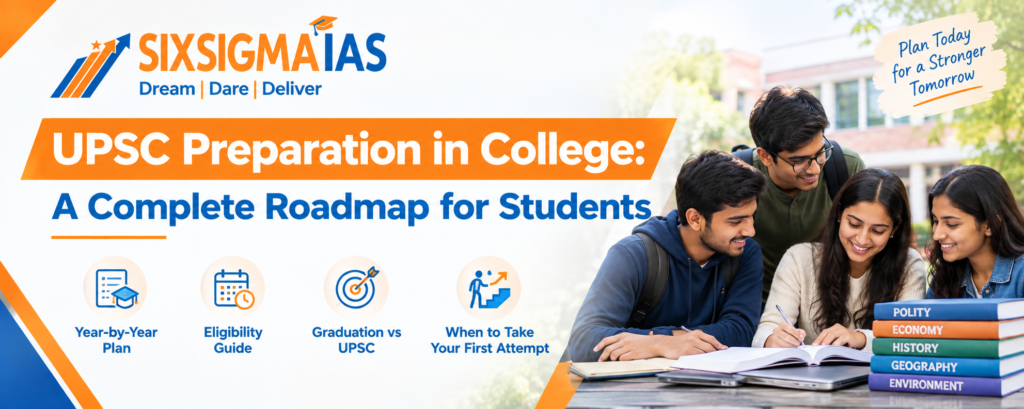
UPSC Preparation in College: A Complete Roadmap for Students
If you are in college and thinking about the civil services, you have one big advantage over most aspirants: time. You can build the foundation slowly, without the pressure of having already graduated and feeling the years run out.
You also face a real risk. It is easy to let UPSC preparation take over your college years, so that your degree suffers, your marks drop and you graduate with neither a strong academic record nor a finished preparation. We see both kinds of students every year.
This post sets out a year-by-year roadmap for UPSC preparation in college, answers the question of whether graduation or UPSC should come first, and explains when a first attempt actually makes sense.
First, the Rules That Matter for Students
A few eligibility points shape everything else, so it is worth getting them clear.
Rule | What it means for you |
You need a bachelor’s degree | Any subject, from a recognised university. There is no minimum percentage. |
Final-year students can apply | You can take Prelims in your final year, but you must have proof of passing your degree by the time you fill DAF-I for Mains. |
Minimum age is 21 | Your age is counted as on 1 August of the exam year. Check this before planning an attempt. |
Attempts are limited | For General and EWS candidates, 6 attempts up to age 32. OBC, SC/ST and PwBD candidates get more attempts and a higher age limit. |
Appearing in Prelims counts as an attempt | Applying and not appearing does not count. Sitting the paper does, even if you are not ready. |
That last point matters a lot for students. Many take Prelims in their final year “just for experience”. If you are genuinely well prepared, that is fine. If you are not, you have used one of your six attempts on practice you could have got from a mock test.
Graduation or UPSC: Which Should Come First?
Our answer is clear: graduation comes first. That doesn’t mean UPSC has to wait. It means that when the two clash, your degree wins.
Here is why.
You need a backup. UPSC is a difficult examination with a small number of vacancies. Many capable people do not get selected, or take several attempts. A good degree, with good marks, keeps other doors open: a job, a master’s degree, other government exams. Graduating with poor marks because you were preparing for UPSC leaves you with fewer choices if UPSC takes longer than planned.
Your degree shows up in your DAF. Your graduation subject, college and marks go into the form the interview board reads. Boards regularly ask questions from a candidate’s graduation subject. A candidate who studied Economics for three years and cannot answer basic Economics questions makes a poor impression.
Your degree can help your preparation. Many graduation subjects overlap directly with the UPSC syllabus: History, Political Science, Economics, Geography, Sociology, Public Administration, and many science and engineering topics. Studying your degree properly is often UPSC preparation in itself.
Serious preparation needs your full attention. The intensive phase of UPSC preparation, with daily answer writing, full-length tests and complete revisions, is very hard to do alongside college exams and assignments. For most students, it works better after graduation, or in the final year once coursework is lighter.
So the right approach for most students is this: use your college years to build the foundation, keep your marks strong, and start full-time preparation around the end of your degree.
A Year-by-Year Roadmap
This is written for a three-year degree. If you are in a four-year programme such as B.Tech, stretch the first two stages across the first three years.
First year: build the reading habit
The goal in first year is not to “start UPSC”. It is to become someone who reads, follows the news and understands how the country works.
- Read a good newspaper daily, even for 30 to 40 minutes. The Hindu or The Indian Express are the usual choices.
- Start the NCERT books from class 6 to 12 in History, Geography, Polity and Economics, slowly. Two or three chapters a week is enough. Our NCERT reading listgives the order.
- Read the UPSC syllabus once, just to know what it covers.
- Take part in debates, college societies, NSS or NCC if you enjoy them. They build confidence and give you something real to talk about in an interview years later.
Time needed: around one to two hours a day, less during exams.
Second year: build the base
- Finish the NCERTs.
- Start one standard book, usually Polity first because it is the most self-contained subject.
- Begin short notes on what you read, and start revising them.
- Start thinking about your optional subject. You don’t need to decide yet, but read a little about the main options and see how they relate to your degree. Our guide on choosing an optional subjectcan help.
- Write one or two practice answers a week, just to get used to it.
Time needed: around two to three hours a day during term, more during vacations.
Third (final) year: decide and plan
- Keep your final-year marks strong. This matters.
- Continue the standard books across the main GS subjects.
- Decide your optional subject by the middle of the year.
- Solve previous years’ Prelims papers to understand the level.
- Decide honestly whether to attempt Prelims in this year or the next.
Should you attempt in your final year? If you are at least 21 by 1 August of that year, have covered most of the GS syllabus, and are scoring reasonably well in full-length mock tests, a final-year attempt can make sense. If not, it is usually better to wait a year. Remember that the attempt counts either way.
The year after graduation: full-time preparation
This is when most students move into full preparation: completing the GS syllabus, finishing the optional, regular answer writing and tests, and revision. Thanks to the foundation from college, this year goes much faster than it does for someone starting from zero.
Using Vacations Well
College vacations are the most valuable time a student has for UPSC preparation. A two-month summer vacation, used properly, can cover a whole subject. Many students use one vacation each for Polity, Modern History, Geography and Economy, and keep term time for newspaper reading and revision.
That said, don’t spend every vacation studying. Internships, travel and rest also matter, both for your wellbeing and for your interview later. A candidate who has done something interesting in their college years has much more to talk about.
Common Mistakes Students Make
Skipping classes to prepare. This almost always backfires. Your marks drop and the preparation rarely makes up for it.
Buying too much study material. One good book per subject is enough at this stage.
Taking Prelims unprepared in the final year. It costs an attempt and often knocks confidence.
Joining a full-time coaching course alongside a full-time degree. It is very hard to keep up with both. A lighter foundation programme, weekend classes or self-study usually suits students better.
Comparing yourself with others. Some of your classmates will seem to be far ahead, and some will say they are studying ten hours a day. Your own steady progress matters much more.
How Six Sigma IAS Academy Works With Students
At Six Sigma IAS Academy, we meet many college students who want to start early, and many parents who want to know whether their child is starting too early. Our advice, under the mentorship of Dr. Shikha Darbari, a 1990-batch IRS officer, is usually the same: start slowly, protect your degree, and build a foundation that makes the full-time preparation year much easier. A mentor can help a student decide how much time to give UPSC in each year of college and when the first attempt should be.
Frequently Asked Questions
Can I start UPSC preparation in college? Yes, and starting early has real advantages. In the first two years, focus on reading the newspaper and the NCERT books. Serious, full-time preparation usually works best in the final year or after graduation.
Should I prioritise graduation or UPSC preparation? Graduation. Good marks keep other career options open, your graduation subject is often discussed in the interview, and many degree subjects overlap with the UPSC syllabus. UPSC preparation in college should build around your degree, not replace it.
Can final-year students apply for UPSC? Yes. Final-year students can take Prelims, but they must have proof of passing their degree by the time they fill DAF-I for Mains. You must also be at least 21 years old as on 1 August of the exam year.
Should I take UPSC Prelims in my final year just for experience? Only if you are well prepared. Sitting Prelims counts as one of your attempts, even if you only went for practice. Mock tests give you the same experience without using an attempt.
How many hours should a college student study for UPSC? One to two hours a day in first year and two to three hours in second and final year is enough to build a strong foundation, with more during vacations. Our post on daily study hourscovers this in more detail.
Does my graduation percentage matter for UPSC? Not for eligibility, since there is no minimum percentage. But your marks appear in your DAF, and a good academic record matters for your backup options if UPSC takes longer than planned.
Six Sigma IAS Academy C-6, Ground Floor, Sector 2, Noida – 201301 (near Noida Sector 15 Metro Station) Visit sixsigmaias.com to talk to a mentor about planning your UPSC preparation alongside college.