

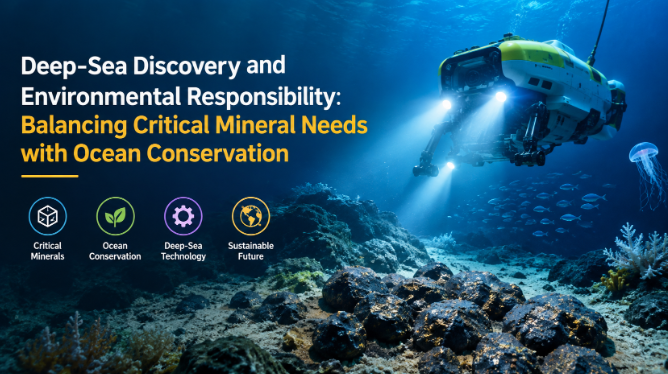
Deep-Sea Discovery and Environmental Responsibility: Balancing Critical Mineral Needs with Ocean Conservation
India's growing deep-sea exploration capabilities are opening new possibilities for resource security, but they also raise important questions about the protection of poorly understood deep-ocean ecosystems. This article examines deep-sea mining, the Deep Ocean Mission, critical minerals, environmental risks and the ethical principles that can guide responsible decision-making.

Why Is Deep-Sea Mining in the News?
Recent discussion on deep-sea exploration focuses on whether India's technological capabilities should automatically lead to commercial seabed mining. The central issue is how to balance the need for critical minerals with the conservation of deep-ocean ecosystems that remain poorly understood.
India's Deep-Sea Exploration: Key Background
- India holds three exploration contracts with the International Seabed Authority (ISA) covering nearly 95,000 sq. km in the Central Indian Ocean Basin, Central Indian Ridge and Carlsberg Ridge.
- These areas are estimated to contain around 366 million tonnes of polymetallic nodules rich in nickel, copper, cobalt and manganese.
- Under the Deep Ocean Mission (DOM), India is developing deep-sea mining technologies, underwater robotics and the MATSYA-6000 human submersible.
- The National Institute of Ocean Technology (NIOT) has tested deep-sea mining equipment at depths exceeding 5,000 metres.
- Scientists continue to identify new marine species and ecosystems, highlighting the ecological sensitivity of the deep ocean.
What Is Deep-Sea Mining?
Deep-sea mining refers to the extraction of minerals from the ocean floor, typically at depths of 3,000–6,000 metres. The main targets include polymetallic nodules, polymetallic sulphides and cobalt-rich ferromanganese crusts.
Polymetallic Nodules
These deposits contain nickel, copper, cobalt and manganese—minerals associated with batteries, electric vehicles, renewable energy technologies, defence systems and electronics manufacturing.
Potential Strategic Importance
Deep-sea mineral deposits are considered a potential future source of strategic minerals and may contribute to resource security.
India's Deep Ocean Mission (DOM)
The Deep Ocean Mission is a flagship initiative launched in 2021 under the Ministry of Earth Sciences. It aims to explore and sustainably utilize ocean resources, support India's Blue Economy vision, and promote deep-sea technology development and scientific research.
MATSYA-6000
- Indigenous human-operated submersible.
- Designed to carry three scientists.
- Capable of reaching depths of 6,000 metres.
- Has completed integrated demonstrations.
Deep-Sea Mining System
Developed by NIOT, the system is designed for sustainable harvesting of polymetallic nodules and has been tested at depths exceeding 5,270 metres.
Deep Ocean Survey and Exploration
The mission also includes seabed resource mapping, biodiversity assessment, environmental baseline studies and resource estimation.

Why Are Deep-Sea Minerals Important?
Polymetallic nodules contain nickel, cobalt, copper and manganese. The source material identifies these minerals as important for the energy transition and strategic industries.
| Mineral / Resource | Applications identified in the source |
|---|---|
| Nickel | Lithium-ion batteries, electric vehicles and strategic applications |
| Cobalt | Lithium-ion batteries and strategic industries |
| Copper | Renewable-energy and electrical infrastructure |
| Manganese | Energy-storage and industrial applications |
Environmental Concerns of Deep-Sea Mining
1. Biodiversity Loss
Deep oceans contain unique and poorly understood ecosystems. Many species remain undiscovered, and mining activities may permanently destroy habitats. Recovery of deep-sea ecosystems could take centuries.
2. Sediment Plumes
Mining can disturb seabed sediments. Sediment clouds may spread across large areas and affect marine organisms and food chains, while long-term impacts remain uncertain.
3. Noise and Vibration Pollution
Mining machinery generates underwater noise that can interfere with marine biodiversity and disrupt ecological processes. Scientific understanding of these effects remains limited.
4. Irreversible Ecological Damage
Deep-sea ecosystems recover extremely slowly. Some species could become extinct before they are scientifically documented, creating a risk that ecological losses could outweigh short-term economic gains.
The Ethical Question: Just Because We Can, Should We?
Technological capability does not automatically justify exploitation. The debate involves both technological feasibility and responsible decision-making.
Key Ethical Principles
- Intergenerational equity
- Precautionary principle
- Sustainable development
- Stewardship of global commons
- Protection of natural capital
- Conservation of biodiversity
International Seabed Authority (ISA)
The International Seabed Authority is an autonomous international organization established under UNCLOS. It regulates mineral-related activities in international seabed areas and treats seabed resources as the Common Heritage of Humankind, while balancing resource utilization with environmental protection.
India and the ISA
- India became a Pioneer Investor in deep-sea exploration.
- India holds three active exploration contracts.
- India was the first ISA member to hold two contracts for polymetallic sulphide exploration.
- India participates in the formulation of global deep-sea mining regulations.
Mission LiFE and Sustainable Resource Use
Mission LiFE (Lifestyle for Environment) promotes sustainable consumption, resource efficiency, circular-economy principles and reduced unnecessary extraction of natural resources. It aligns development with environmental responsibility.
Can India Lead a Different Model?
The source argues that India can become a leader not only in deep-sea technology but also in deep-sea ecological governance, responsible resource management and a sustainable Blue Economy.
- Deep-sea ecological governance
- Responsible resource management
- Sustainable Blue Economy
- Nature-based development
- Evidence-based environmental policymaking
- Global ocean conservation efforts
Conclusion
India's deep-sea exploration achievements represent a major scientific and technological milestone. However, the key question is not only whether deep-sea minerals can be extracted, but whether extraction should proceed without fully understanding the ecological consequences.
Sustainable development requires balancing resource security with environmental responsibility, ensuring that the pursuit of economic growth does not irreversibly damage one of Earth's least understood ecosystems.