

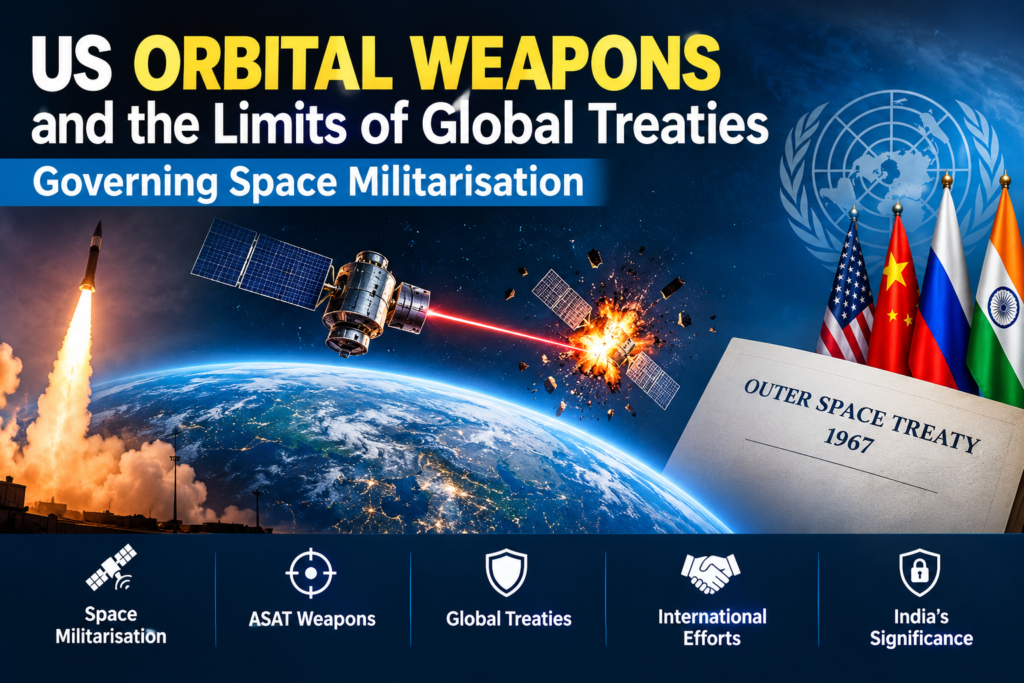
US Orbital Weapons and the Limits of Global Treaties Governing Space Militarisation
GS3 – Internal Security: Defence technology, strategic security challenges and weaponisation of outer space.
GS2 – International Relations: International treaties, global governance and multilateral disarmament frameworks.
Why in News?
The United States publicly acknowledged that it has deployed weapons in space, marking the first official admission by any country regarding the deployment of orbital weapons.
The statement has revived global debate over the militarisation and weaponisation of outer space and highlighted the limitations of existing international legal frameworks governing space activities.
Background
- The US stated that it possesses on-orbit space control weapons capable of defending its space assets.
- The announcement did not specify the nature, capability or deployment timeline of these weapons.
- China and Russia criticised the move and called for preventing an arms race in outer space.
- The development has renewed concerns regarding growing military competition among major space powers.
- It has also drawn attention to the limitations of existing treaties in regulating conventional weapons in space.
What is Space Militarisation and Weaponisation?
Space Militarisation
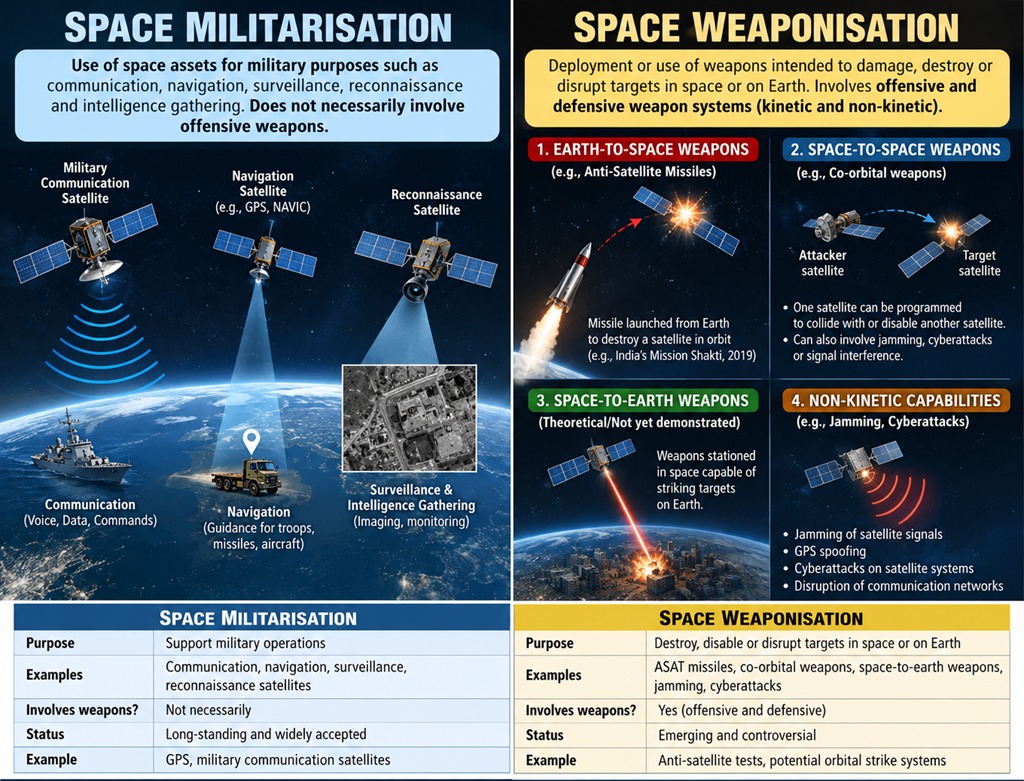
Space militarisation refers to the use of space assets for military purposes such as communication, navigation, reconnaissance, surveillance and intelligence gathering.
- Includes military satellites supporting terrestrial military operations.
- Has existed since the Cold War era.
- Does not necessarily involve offensive weapons in space.
Space Weaponisation
Space weaponisation refers to the deployment or use of weapons intended to damage, destroy or disrupt targets in space or on Earth.
- Involves offensive and defensive weapon systems.
- Includes kinetic as well as non-kinetic capabilities.
- Represents a more advanced stage of military competition in outer space.
Major Categories of Space Weapons
1. Earth-to-Space Weapons
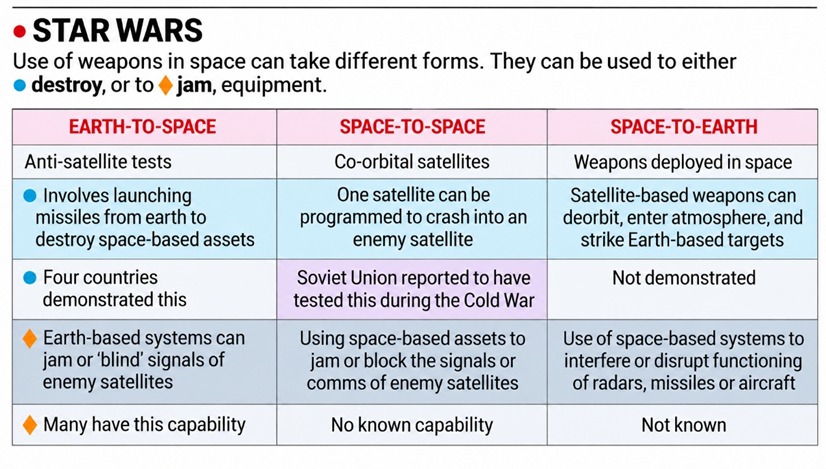
- Involve launching missiles from Earth to destroy satellites in orbit.
- Commonly known as Anti-Satellite (ASAT) weapons.
- Demonstrated by the United States, Russia, China and India.
- India successfully tested ASAT capability under Mission Shakti (2019).
- Can also include electronic warfare systems capable of jamming satellite signals.
2. Space-to-Space Weapons
- One satellite may be programmed to interfere with, disable or collide with another satellite.
- Includes co-orbital systems operating near target satellites.
- May involve signal interception, cyberattacks or communication disruption.
- Such systems can be difficult to detect and verify.
3. Space-to-Earth Weapons
- Involve weapons stationed in space capable of striking terrestrial targets.
- Such systems remain largely theoretical and have not been publicly demonstrated.
- Could potentially attack military infrastructure on Earth.
- Raise serious concerns regarding strategic stability.
Non-Kinetic Space Warfare Capabilities
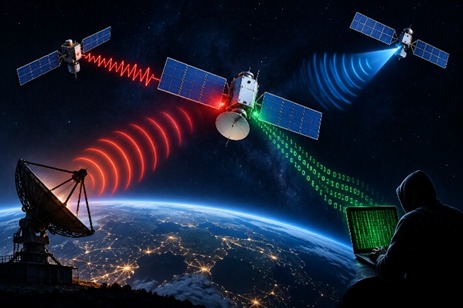
Modern space warfare may occur without physical destruction of satellites or other space assets.
- Satellites can be disabled through electronic jamming.
- Cyberattacks can target satellite control systems and ground stations.
- GPS signals may be spoofed or disrupted.
- Communication and surveillance networks can be degraded.
- Such attacks are often difficult to attribute to a specific actor.
Existing International Legal Framework
Outer Space Treaty, 1967
The Outer Space Treaty 1967 is considered the foundation of international space law.
- Prohibits placement of nuclear weapons and other weapons of mass destruction in outer space.
- Mandates peaceful use of celestial bodies.
- Prevents national appropriation of outer space.
- Does not prohibit conventional weapons in space.
Key Limitations of the Existing Framework
| Issue | Limitation |
|---|---|
| ASAT Weapons | The framework is largely silent on Anti-Satellite weapons. |
| Conventional Weapons | It does not comprehensively regulate conventional orbital weapons. |
| Cyber Warfare | Cyber operations targeting space systems are not comprehensively addressed. |
| Verification | There is no comprehensive verification mechanism. |
| Emerging Technologies | Many emerging space military technologies are not specifically defined or regulated. |
International Efforts to Prevent an Arms Race in Space
Prevention of the Placement of Weapons in Outer Space (PPWT)
- Proposed jointly by Russia and China.
- Sought to prohibit deployment of weapons in outer space.
- Intended to prevent use or threat of force against space objects.
- Failed to gain universal acceptance.
- Concerns existed regarding verification and enforcement.
PAROS – Prevention of an Arms Race in Outer Space
PAROS is a long-standing agenda item at the United Nations Conference on Disarmament.
- Seeks legally binding measures to prevent weaponisation of space.
- Discussions have continued for decades.
- No comprehensive treaty has emerged.
Artemis Accords
- Led by the United States and NASA.
- Establish voluntary principles for peaceful space exploration.
- Focus on transparency, interoperability and responsible behaviour.
- Do not prohibit deployment of weapons in space.
- India is among the signatories.
Implications for Global Security
- Growing dependence on satellites increases vulnerability of nations.
- Destruction of satellites can disrupt communication, navigation, banking, weather forecasting and military operations.
- Space warfare could generate large quantities of orbital debris.
- Orbital debris threatens civilian and commercial satellites.
- Escalation in space may trigger broader geopolitical conflicts on Earth.
- Raises concerns regarding strategic stability among major powers.
Significance for India
India is an emerging space power with critical strategic space assets. ISRO and defence agencies increasingly rely on satellite infrastructure.
- India's ASAT capability demonstrated technological competence.
- India supports peaceful use of outer space while safeguarding national interests.
- Future policy must balance space security requirements with international cooperation.
Conclusion
The US admission regarding orbital weapons has reignited concerns over the weaponisation of outer space and exposed significant gaps in existing international legal frameworks.
As military competition expands beyond Earth, strengthening global norms and developing effective regulatory mechanisms will be crucial to ensuring that outer space remains secure, stable and accessible for all nations.
Important Keywords
```