
UPSC Mains Answer Writing: Proven Techniques to Score 450+ Marks
Here is a pattern that repeats every year: two aspirants know almost exactly the same material, sit the same Mains papers — and one clears with a comfortable margin while the other misses by a whisker. The difference is rarely knowledge. It’s answer writing.
UPSC Mains is not a test of how much you know; it’s a test of how well you present what you know, under severe time pressure, in exactly the way the examiner asked. This is why two candidates with similar preparation can score 60 marks apart in the same GS paper. Master the craft of UPSC answer writing, and a high aggregate across the four GS papers — the kind of 450+ that separates strong rankers from the crowd — moves from wishful thinking to a realistic target.
This guide breaks that craft down into techniques you can practise and improve.
Why answer writing decides your Mains rank
The four General Studies papers carry 1000 marks (250 each), the Essay carries 250, and your optional another 500 — a total of 1750 marks that decide your merit, almost all of it written under the clock. Consider the arithmetic of a single GS paper: roughly 20 questions in 3 hours. That’s about 7–9 minutes per answer, including thinking time, to produce a structured, substantiated response.
Under that pressure, the aspirant who has practised writing — who structures instantly, answers the directive precisely, and stops on time — has an enormous advantage over the one who knows more but writes slower and messier. Answer writing is a skill, not a body of knowledge, and skills are built only through practice and feedback.
Understand the GS papers before you write
Each of the four UPSC GS papers tests a distinct domain, and good answers reflect that domain’s language:
- GS I— Heritage and culture, history, geography, and Indian society.
- GS II— Constitution, polity, governance, social justice, and international relations.
- GS III— Economy, agriculture, science and technology, environment, security, and disaster management.
- GS IV— Ethics, integrity and aptitude, including case studies.
Knowing which paper you’re in shapes your framing — a governance answer in GS II leans on constitutional articles, committees and schemes; an economy answer in GS III leans on data, reports and current developments.
Decode the directive — the marks live here
The single most common reason good aspirants lose marks is not answering what was asked. Every question contains a directive word that tells you exactly what to do. Answer a “critically examine” question as if it said “describe,” and you’ve capped your score no matter how much you write.
Directive | What the examiner wants |
Discuss | Present multiple aspects, arguments for and against |
Analyse | Break the issue into components and show how they relate |
Critically analyse / examine | Analyse and deliver a reasoned judgment weighing merits and demerits |
Examine | Probe deeper, investigate causes and implications |
Evaluate / Assess | Judge value or success with evidence, weighing both sides |
Comment | Give an informed, reasoned opinion |
Elucidate / Explain | Make the concept clear with detail and examples |
Substantiate | Support the given statement with evidence |
Read the directive first, and let it dictate your structure before you write a single line.
The structure of a high-scoring answer
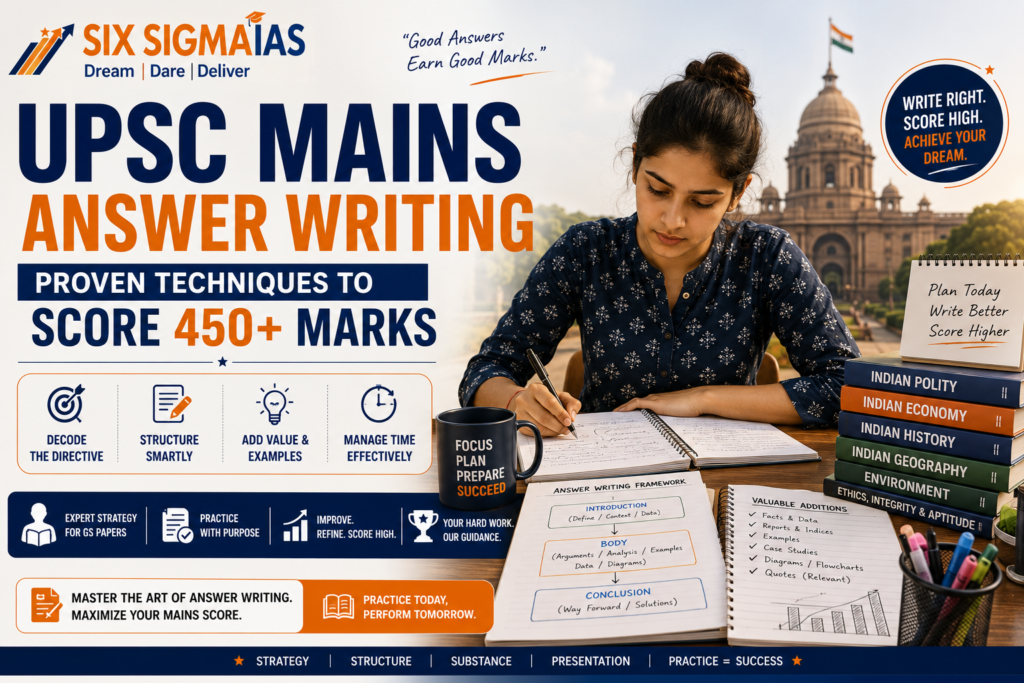
Almost every good answer follows the Introduction–Body–Conclusion framework. Structure isn’t decoration — it makes your answer easy to evaluate, and an examiner marking hundreds of scripts rewards clarity.
Introduction (1–2 lines). Set context crisply — a definition, a relevant fact or data point, a constitutional provision, or the background to the issue. Avoid long wind-ups; get to the point.
Body (the bulk of your marks). This is where you demonstrate depth and, above all, multi-dimensionality:
- Cover multiple angles — social, economic, political, environmental, ethical, administrative — rather than one narrow line.
- Present arguments andcounter-arguments where the directive demands balance.
- Substantiate everything — facts, data, government reports, committee recommendations, Supreme Court judgments, constitutional articles, real-world examples.
- Use subheadings, short paragraphs or crisp pointsso the structure is visible at a glance.
- Add value with diagrams, flowcharts, maps or tableswhere they genuinely aid the answer — a labelled map in a geography answer or a simple flowchart in a governance answer earns attention.
Conclusion (1–2 lines). Close with a balanced, forward-looking, solution-oriented note — a way ahead, a reform, a constitutional value, or an optimistic but grounded outlook. Never end abruptly or on a purely negative note.
A worked example of the approach
Take a question framed as: “Critically examine the role of [a governance reform] in improving public service delivery.”
- Directive= critically examine → you must analyse and give a judgment weighing both sides.
- Introduction→ one line defining the reform and its intent.
- Body→ dimensions where it has improved delivery (efficiency, transparency, reach), backed by examples and data; then the limitations (implementation gaps, exclusion, capacity issues), backed by evidence.
- Conclusion→ a balanced verdict plus a constructive way forward.
Notice that you never “dump everything you know.” You select, structure, and steer every point toward answering the directive. That selectivity is the essence of good IAS answer writing practice.
Techniques that consistently add marks
- Answer the directive precisely— the highest-leverage habit of all.
- Be multi-dimensional— breadth of perspective signals a civil-servant’s mind.
- Substantiate— replace vague assertions with facts, reports, articles and examples.
- Add visual value— diagrams, flowcharts and maps, used purposefully.
- Keep it structured and legible— subheadings, clean handwriting, underlined keywords.
- Stay balanced— show both sides; nuance scores higher than one-sidedness.
- Respect the word limit— quality within limits beats a long, unfocused answer.
- Attempt every question— a blank scores zero; even an average answer earns marks.
GS IV (Ethics): a paper of its own kind
The Ethics paper rewards a slightly different toolkit — precise definitions of ethical terms, real and hypothetical examples, relevant quotes and thinkers, and, in the case studies, a structured approach that identifies stakeholders, the ethical dilemmas, the options with their pros and cons, and a justified course of action. Practise case studies specifically; they can’t be improvised on exam day.
UPSC essay writing: the paper aspirants under-practise
The Essay paper (250 marks) is frequently neglected, yet it’s one of the best return-on-effort papers because so few practise it well. A strong essay is multi-dimensional — weaving philosophical, social, economic, political, historical and personal threads around the theme — with a clear introduction, a logically flowing body, and a reflective, forward-looking conclusion. Use anecdotes, examples and a coherent thread that ties the whole piece together. Write full-length essays regularly and get them reviewed; UPSC essay writing improves dramatically with feedback and almost not at all without it.
Time and word-limit discipline in the exam
The exam is won as much on the clock as on the page. Practical UPSC mains tips for the hall:
- Allocate a fixed time per answer and move onwhen it’s up — don’t let a favourite question steal minutes from three others.
- Attempt allquestions; leaving marks on the table by running out of time is a classic self-inflicted wound.
- Stay within word limits — examiners aren’t paid to reward padding.
- Keep your handwriting legible; an answer that can’t be read can’t be rewarded.
How to build the skill: a practice roadmap
You cannot cram answer writing. Build it deliberately:
- Start early— begin with a few answers a day as soon as your basics in a subject are in place.
- Practise on PYQs— real UPSC questions train you in real UPSC framing.
- Get evaluated— honest, specific feedback on structure, directive-compliance and content is what turns average answers into good ones. This is the single biggest accelerator, and the hardest to get without a mentor.
- Iterate— rewrite weak answers, build model structures for recurring themes, and track your improvement.
- Simulate— write full papers in 3 hours to build speed and stamina before the exam.
This is precisely where guided mentorship earns its keep: self-practice builds volume, but expert evaluation builds quality.
Common answer-writing mistakes to avoid
Writing everything you know instead of answering the question; ignoring the directive; exceeding the word limit; producing an unstructured wall of text; asserting without substantiating; mismanaging time; leaving questions blank; and illegible handwriting. Each of these quietly caps otherwise capable candidates. (Our post on common UPSC preparation mistakes covers these in depth.)
Frequently Asked Questions
- How can I improve my UPSC answer writing?Practise daily on previous year questions, follow the introduction–body–conclusion structure, answer the directive precisely, substantiate with facts and examples, and — most importantly — get your answers evaluated so you can iterate.
- How much time should I spend on each Mains answer?Roughly 7–9 minutes, since you have about 20 questions in 3 hours. Fixed time discipline and attempting every question matter more than perfecting a few.
- What is the ideal structure for a UPSC Mains answer?A crisp introduction, a multi-dimensional and well-substantiated body (with subheadings, points and diagrams where useful), and a balanced, forward-looking conclusion.
- When should I start answer writing practice?As early as possible — begin once your basics in a subject are ready, rather than waiting until after Prelims. It’s a skill that takes months to mature.
- Is the Essay paper important for UPSC Mains?Very. At 250 marks and widely under-practised, the Essay offers strong return on effort. Write full-length essays regularly and get them reviewed.
Final word
The candidates who score 450+ across the GS papers aren’t necessarily the ones who know the most — they’re the ones who write the best: decoding the directive, structuring instantly, substantiating with evidence, adding value, and finishing on time. Every one of those is a learnable, practisable skill. Start writing today, seek honest feedback, and refine relentlessly — because in the Mains hall, the well-written answer beats the well-informed one every single time.
Six Sigma IAS Academy, Sector 2, Noida — UPSC & UPPSC preparation mentored by former civil servants, with structured answer-writing programmes and personalised evaluation. Visit sixsigmaias.com.